Tunisia Agri-Food Exports: $1 Billion in Untapped Potential

Tunisia agri-food exports are performing solidly, yet one fact stands out: the country is still far from tapping its true international potential. According to official figures, the untapped export potential of several flagship Tunisian agri-food products stands at nearly one billion dollars. That's a considerable growth margin for Tunisian farmers, processors and exporters — provided they better target promising markets and diversify beyond their traditional trading partners.
A sector that's already strategic for Tunisia's economy
The agri-food sector is no marginal player in the Tunisian economy. It contributes 3.1% of national GDP and accounts for 23% of value added in the manufacturing sector. It also attracts 25% of all investment in manufacturing industries, a strong signal of investor confidence in the sector.
In terms of employment, the sector accounts for 14% of manufacturing jobs and brings together roughly a thousand active companies across the country. Yet on the export side, its contribution remains modest: the agri-food sector makes up just 13.3% of Tunisia's exports, well behind mechanical and electronic industries (49%) and textiles-clothing (17.5%). It is precisely this gap between the sector's domestic economic weight and its export performance that highlights the still underused competitiveness of Tunisia's agri-food sector.
Markets that remain too concentrated
Tunisian agri-food exports today remain heavily dependent on a limited number of partners. Italy absorbs 16% of Tunisian agri-food exports, followed by Spain with 15%, the United States with 11% and Libya with 10%. While this geographic concentration reflects solid trade relationships, it also limits the sector's ability to seize new opportunities, particularly in Asia and in other European markets that remain largely untapped.
Olive oil, the undisputed export leader
No discussion of Tunisia's agricultural export potential would be complete without a look at olive oil. This single product accounts for more than half of Tunisia's food exports and generates nearly 4 billion dinars in export revenue. Tunisian olive oil is particularly popular in Spain (25% of Tunisian olive oil exports), the United States (22%) and Italy (20%).
This performance confirms Tunisia's place among recognized producers, but it also raises a question: why do these markets remain so concentrated when the product's quality is praised internationally?
Deglet Ennour dates, the second export pillar
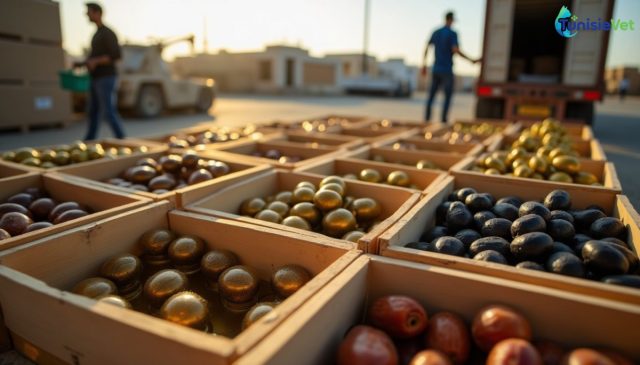
Deglet Ennour dates rank second, accounting for 11% of the agri-food sector's export value. Morocco takes in 18% of them, Germany 11% and France 8%. This iconic product still has room to diversify its outlets further, particularly toward new Asian markets.
Seafood and tomatoes: sectors still to be consolidated
- Seafood, particularly fish, accounts for more than 5% of Tunisia's food exports.
- Tomatoes make up 4% of Tunisia's food exports, with a very high level of concentration: the Netherlands absorbs 74% of Tunisian tomato exports, and Germany 15%.
This heavy reliance on just a few buyer countries once again highlights the need to broaden the international market reach for these sectors.
Growth drivers identified by industry professionals
For those working in the sector, certain niches remain particularly promising. Mourad Ben Hassine, CEO of Cepex, has stated that cherry tomatoes represent a promising area for Tunisia. He also points out that Tunisian agri-food products offer distinctive flavors shaped by the country's climate, environment, quality of light and geothermal waters — a qualitative point of difference that Tunisia could promote more effectively on the international stage.
What paths forward for Tunisian farmers and exporters?
Given this situation, several levers stand out for industry professionals:
- Diversify destination markets beyond traditional partners (Italy, Spain, the United States, Libya).
- Focus on high value-added products with a strong quality identity, such as cherry tomatoes or premium olive oil.
- Strengthen presence in still largely untapped markets, particularly in Asia.
- Promote the specific qualities tied to Tunisian terroir: climate, light, and geothermal waters.
These efforts concern large agri-food companies as much as individual producers, whose success often hinges on the health and productivity of their herds or crops. For farmers involved in these export chains — particularly those raising cattle, sheep or goats destined for agri-food processing — relying on quality veterinary support remains essential to ensure products meet international standards; the directory of livestock veterinary specialists makes it easy to find a professional near your farm.
Can the untapped potential really reach $1 billion?
Based on available data, the untapped export potential of several flagship Tunisian agri-food products does indeed stand at close to one billion dollars. This figure reflects the gap between the recognized quality of Tunisian products and their currently limited diversification toward new markets, particularly in Asia.
Tunisia's agri-food sector therefore holds real strengths: recognized supply chains, quality products and committed professionals. What remains is turning this potential into concrete results by diversifying markets and showcasing Tunisian quality on the world stage.
Leave a comment
Be the first to comment on this article.