
Presentation
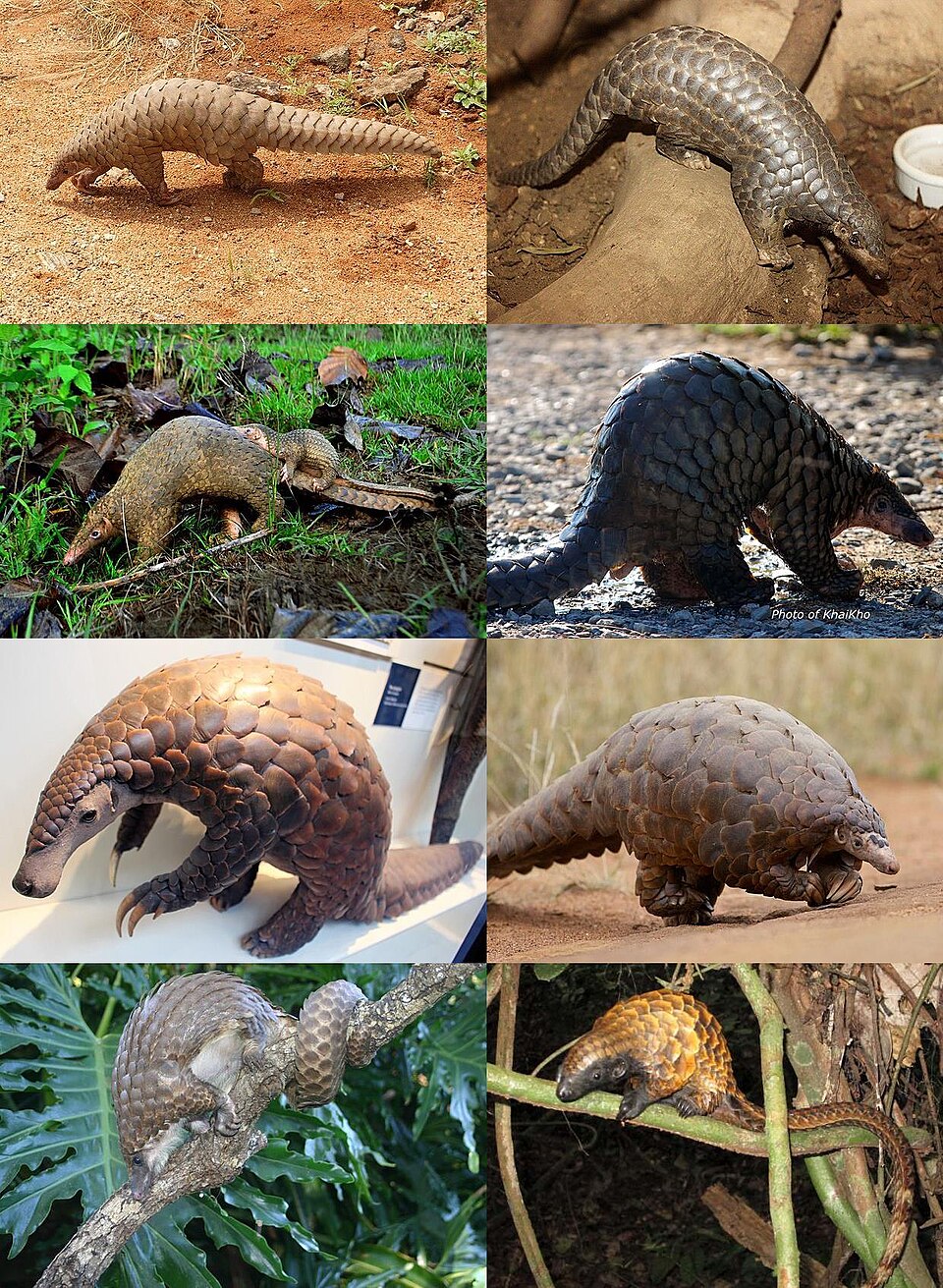
Pangolin is a mammal covered in keratinized scales, unique in its kind among current mammals. There are eight species distributed between Africa and Asia, living both on the ground and in trees depending on the species. A nocturnal and discreet animal, it feeds almost exclusively on ants and termites which it captures using a very long and sticky tongue. The Pangolin is today the mammal most heavily trafficked in illegal wildlife, due to the demand for its scales and meat. Its particular morphology and its defensive behavior, which consists of rolling up into a ball, make it easily identifiable.
Pangolin's body is covered in interlocking scales composed of keratin, forming a protective armor unique among mammals. It has a long prehensile tail in certain arboreal species, small clawed legs adapted to burrowing, and a thin head devoid of teeth. Its tongue can measure a length close to that of its body and retracts into an internal pocket. His eyesight is weak but his sense of smell is very developed.
Characteristics
Indicative values: they vary by subspecies, sex and region.
Habitat and distribution
Depending on the species, Pangolin frequents dense tropical forests, wooded savannahs or shrub-steppe areas. Arboreal species live in the canopy while terrestrial species dig burrows in the ground. It favors areas with abundant access to ant and termite colonies.
CURRENT RANGE
The Pangolins are divided into two distinct geographic groups: four species live in sub-Saharan Africa and four others in South and Southeast Asia. No species is naturally present in Tunisia or North Africa. Their range has been greatly reduced due to deforestation and intensive poaching.
Behaviour
The Pangolin is a solitary and mainly nocturnal animal. Depending on the species, it is terrestrial and digs burrows, or arboreal and moves in the canopy using its prehensile tail. When faced with a threat, it rolls up into a compact ball, its sharp scales offering effective protection against most predators. It communicates little and sometimes marks its territory with odorous secretions.
Reproduction
The female generally gives birth to a single young after a gestation of several months, the duration of which varies depending on the species. The newborn is born with soft scales which gradually harden over a few days. It remains dependent on its mother for several months, often clinging to the base of its tail when moving. Sexual maturity is reached around the age of two.
Peculiarities
Pangolin is the only mammal in the world completely covered in keratin scales. It also represents the most poached and illegally trafficked mammal worldwide. Its ability to completely curl into an impenetrable ball is a remarkable defensive adaptation.
Threats and conservation
The Pangolin is extremely threatened by poaching for the illegal trade of its scales, used in certain traditional Asian medicines, as well as by the consumption of its meat considered a luxury delicacy. Deforestation is also reducing its natural habitat. Several species are classified as critically endangered by the IUCN.
Numbers and trends vary across sources and regions. See the IUCN assessment for the latest reference data.
Gallery
1 documented photographs.
References
Profile updated 26 August 2026 · Reviewed by the TunisieVet editorial team.
Comments (0)
No comments yet.
CONSERVATION STATUS
Endangered (EN)
IUCN source, latest published assessment.
Species health
Documented diseases for this species.
This information is provided for educational purposes only and is not a substitute for a veterinary consultation. If you have any concerns about your animal's health, consult a veterinarian.
To discover around: Pangolin
Videos, facts, stories and records linked to this species.
Similar animals
Other species documented in Animalpedia.

TunisieVet in your pocket 📱🐾 Access your veterinary services wherever you are. [ Download the app ]
Learn more