How can a snake swallow prey bigger than its head?
92 views · 1 month ago
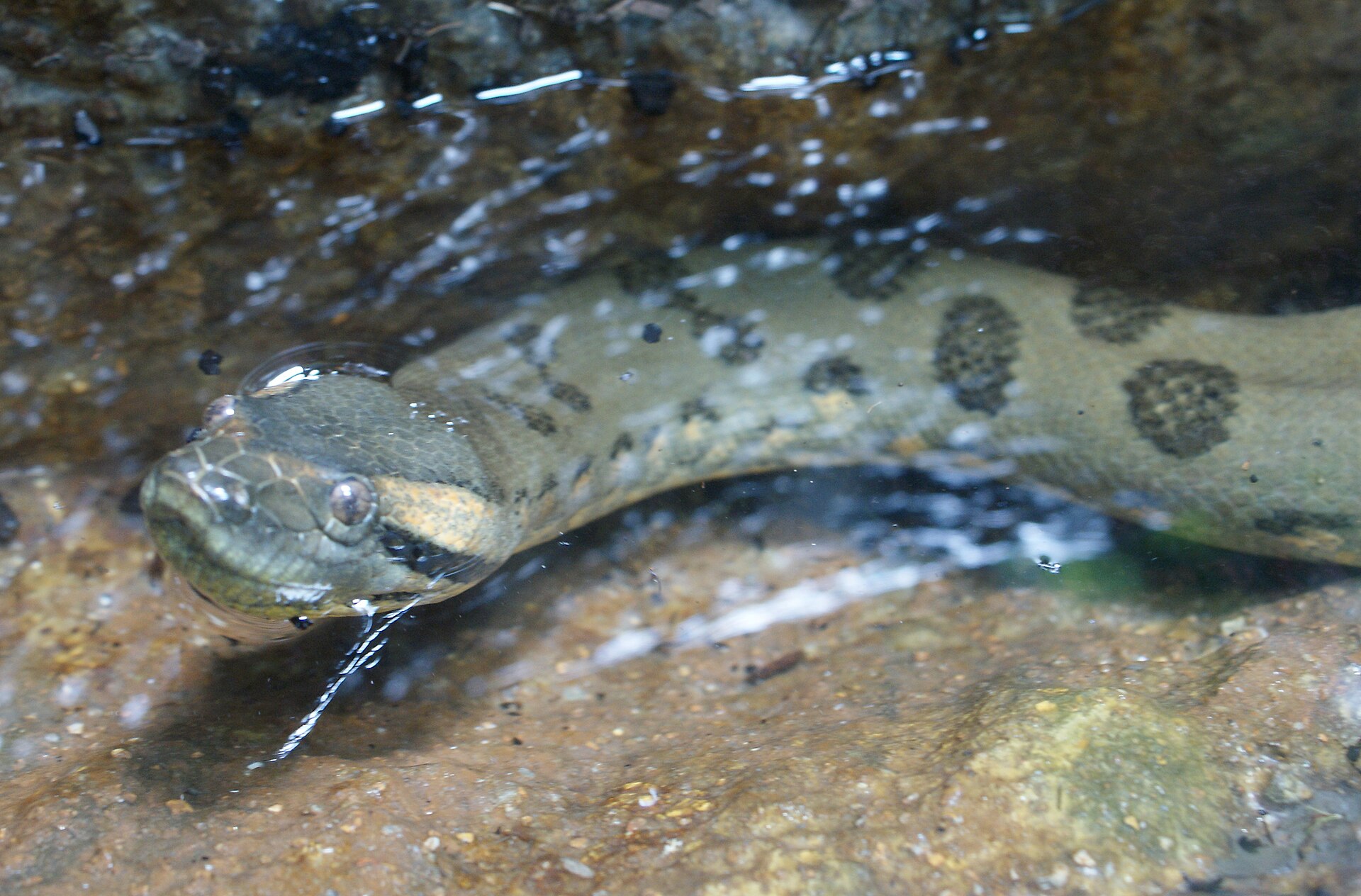
The green anaconda does not have a “disconnected” jaw: contrary to popular belief, the two halves of its lower mandible do not dislocate. They remain connected by a very extensible elastic ligament which allows them to spread widely and advance alternately, one then the other, to pull the prey inward.
An alternating advance mechanic
In Eunectes murinus, the bones of the skull and upper jaw are connected together by flexible ligaments rather than by rigid sutures as in mammals. Each half of the lower mandible bears rows of teeth curved backwards: when one half advances on the prey, the other remains anchored, then they alternate, a bit like a left-right walk, until the prey is entirely engulfed. This mechanism, called bipedal jaw movement, is well documented in large boids.
The skin and muscles of the throat are themselves extremely extensible, with elastic ligaments between the squamosal and quadrate bones that allow a mouth opening well beyond the usual diameter of the head. In an adult green anaconda, whose body circumference can exceed 30 cm, this extensibility makes it possible to ingest prey such as capybaras or young caimans, which are much larger than the skull of the snake at rest.
Publicité
Publicité
Another key point: during this swallowing, which can last long minutes, or even several hours for large prey, the animal must continue to breathe. The trachea is offset forward, at the base of the mouth, and can be pushed forward like a small rigid tube which remains clear even when the pharynx is completely filled by the prey.
Digestion that mobilizes the entire body
After such a meal, often spaced several weeks apart in green anacondas, the metabolism accelerates significantly: the heart and digestive organs temporarily increase in volume to cope with the influx of energy necessary for the digestion of massive prey. This phenomenon, well studied in large snakes, illustrates the extent to which the entire body, and not just the jaw, is adapted to this infrequent but very caloric mode of eating.