
Presentation
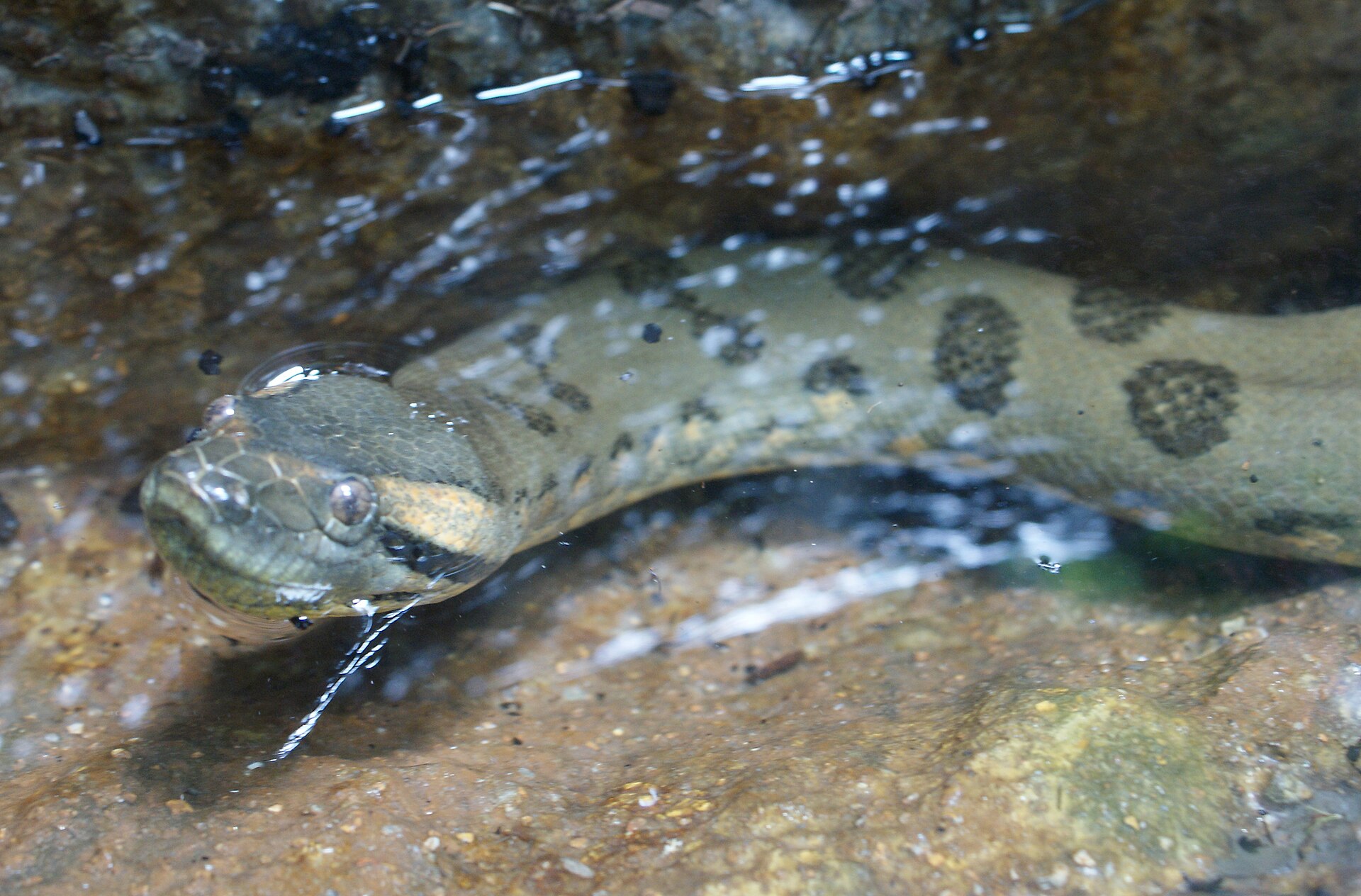
The Green anaconda is one of the largest snakes in the world, recognizable by its brilliant green coloring which camouflages it perfectly in aquatic vegetation. This semi-aquatic constrictor snake is perfectly adapted to life in the humid environments of South America, where it reigns as the dominant predator.
Robust and massive body, covered with smooth emerald green to dark green scales, sometimes with yellow spots or bands. Triangular head with eyes and nostrils positioned on top of the skull, allowing the snake to remain submerged while breathing. Thick, muscular skin, adapted to compressing large prey.
Did you know?
How can a snake swallow prey bigger than its head?
Characteristics
Indicative values: they vary by subspecies, sex and region.
Habitat and distribution
Inhabiting the tropical rainforests of South America, the Green anaconda favors areas of rivers, swamps and shallow lakes, particularly in the Amazon and Orinoco basins. It also frequents areas of dense vegetation with stagnant or running water nearby.
CURRENT RANGE
Endemic to tropical South America, Green anaconda is distributed in Colombia, Ecuador, Peru, Bolivia, Venezuela and Brazil. Its range mainly covers the Amazon basin and adjacent regions, including the Orinoco river systems.
Behaviour
Primarily nocturnal and semi-aquatic snake, spending most of its time in shallow rivers and lakes. An excellent swimmer, he moves slowly on land but with great agility in the water. Generally solitary and territorial, it hunts in ambush, waiting for its prey motionless on the surface.
Reproduction
Viviparous species; the female gives birth to young directly, with a gestation period of approximately 5 to 6 months. A female can give birth to between 20 and 40 young measuring approximately 60 to 80 cm. Newborns are immediately independent and carnivorous.
Peculiarities
The Green anaconda is the heaviest snake in the world in terms of total body mass, surpassing even the boa constrictor. Its ability to hold its breath underwater can exceed an hour, making it a formidable hunter in the aquatic environment. Its bright green color makes it almost invisible under floating aquatic plants.
Threats and conservation
Currently not very threatened, the Green anaconda benefits from an IUCN status of Least Concern. However, the gradual destruction of its natural habitat through deforestation and agricultural exploitation in the Amazon basin poses long-term risks for populations.
Numbers and trends vary across sources and regions. See the IUCN assessment for the latest reference data.
Gallery
1 documented photographs.
References
UICN — Liste rouge des espèces menacées
Profile updated 28 August 2026 · Reviewed by the TunisieVet editorial team.
Comments (0)
No comments yet.
CONSERVATION STATUS
Least concern (LC)
IUCN source, latest published assessment.
Species health
Documented diseases for this species.
This information is provided for educational purposes only and is not a substitute for a veterinary consultation. If you have any concerns about your animal's health, consult a veterinarian.
To discover around: Green anaconda
Videos, facts, stories and records linked to this species.
Similar animals
Other species documented in Animalpedia.

TunisieVet in your pocket 📱🐾 Access your veterinary services wherever you are. [ Download the app ]
Learn more