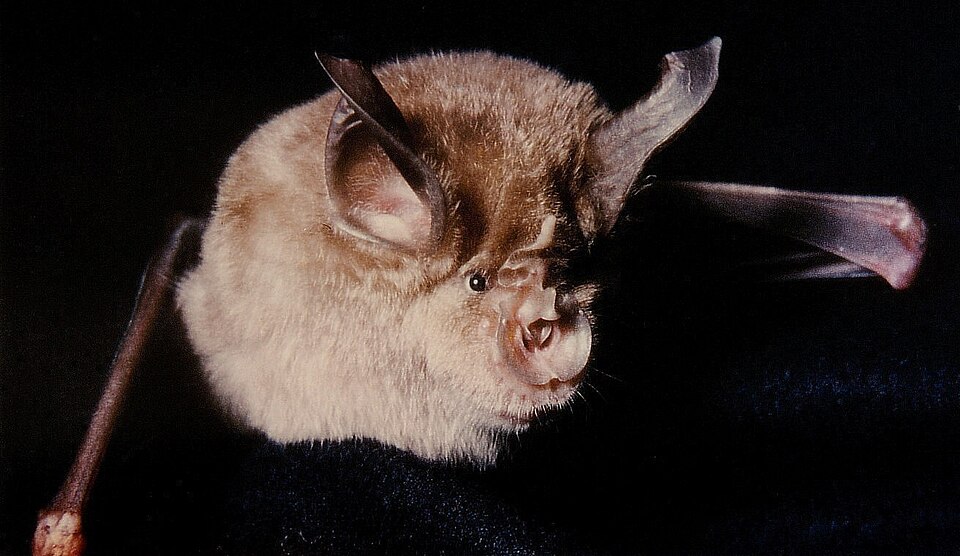
The wing of the greater horseshoe bat has no feathers because it is not a wing in the avian sense: it is a hand with disproportionately elongated fingers, covered with a thin membrane of skin, the patagium. Each finger remains mobile and allows fine control of the canopy, impossible to reproduce with a structure fixed like a feather.
A hand transformed into an articulated wing
In the greater horseshoe bat, as in all bats, four fingers of the hand have lengthened considerably during evolution to stretch a flexible skin membrane, the patagium, which connects these fingers to each other, to the body and often to the hind limbs and the tail. Only the thumb remains short and free, equipped with a claw used for climbing or clinging. This architecture means that the animal literally flies with its hands: each phalangeal joint can bend or tense independently, modifying the tension, curvature and surface area of the membrane in flight.
This digital mobility offers an aerodynamic plasticity that the feathered wing of a bird, more rigid in its bone structure, does not possess to the same degree. The greater horseshoe bat can thus partially fold a wing, locally curve the membrane or modify the angle of a single finger to instantly adjust its lift. This ability partly explains its slow and very maneuverable flight, with sudden changes of direction and a brief hovering flight, useful for hunting in crowded environments such as hedges, edges or inside caves that it frequents.
Publicité
Publicité
The membrane itself is alive: covered with blood vessels, elastic fibers and sensitive nerve endings, it also participates in thermoregulation and the tactile perception of air flow, two functions that a feather, a dead structure once formed, cannot provide.
Agility for acoustic hunting
This controllable hand-wing combines in the Greater Horseshoe Bat with echolocation through the nose, for almost immobile precision flight near the foliage. This approach differs radically from the stable lift sought by gliding or migratory birds, for whom the rigidity of the feather is an asset rather than a constraint.