
Presentation
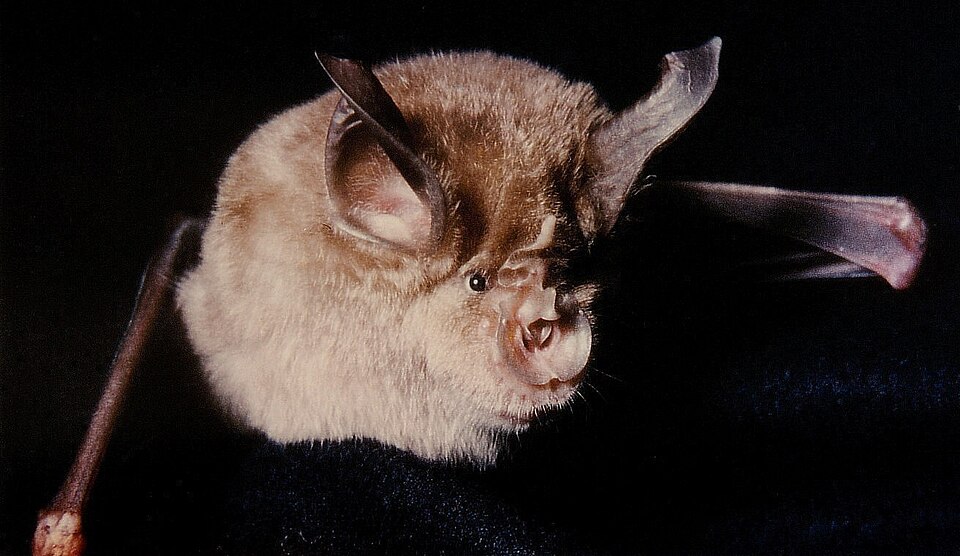
The Greater horseshoe bat is a medium-sized bat characterized by a very distinctive facial structure. Its nose has a complex of skin folds shaped like a horseshoe, hence its scientific name. It is one of the largest species of horseshoe bats in Europe and North Africa.
The Greater horseshoe bat has large, pointed ears, lacking a tragus (internal cartilaginous projection). Its wings are broad and rounded, suitable for slow, maneuverable flight. The wing membrane extends to the base of the toes, forming a sac between the legs.
Did you know?
What is the smallest mammal in the world?
Characteristics
Indicative values: they vary by subspecies, sex and region.
Habitat and distribution
The Greater horseshoe bat inhabits deciduous forests and mountainous areas of Europe and North Africa. It prefers semi-open landscapes, groves, meadows and agricultural areas dotted with trees, with proximity to caves or underground structures for resting.
CURRENT RANGE
The Greater horseshoe bat is distributed in Southern and Central Europe, North Africa, and Western Asia. Its range extends from Portugal to Iran, with populations in France, Spain, Italy, Greece and the Maghreb, including Tunisia.
Behaviour
It is a nocturnal species which roosts during the day in caves, abandoned mines or buildings. It uses echolocation with high frequency screams emitted from the mouth. It flies slowly and close to the ground, capable of hovering to catch its prey.
Reproduction
The Greater horseshoe bat mates in autumn after a long ritual mating. Females give birth to one young per year, usually in June-July. Breastfeeding lasts approximately 5 weeks. The young fly independently after 6 to 8 weeks.
Peculiarities
Its complex nasal system (nasal sheet) plays a crucial role in the emission of directional echolocation ultrasound. The Greater horseshoe bat can hear the very subtle noises made by insects, allowing it to hunt extremely precisely. Its long ear hairs are richly innervated and sensory.
Threats and conservation
Major threats include habitat loss and fragmentation, pesticide use reducing insect populations, and roost disturbance. Climate change also affects seasonal cycles and insect availability.
Numbers and trends vary across sources and regions. See the IUCN assessment for the latest reference data.
Gallery
1 documented photographs.
References
UICN — Liste rouge des espèces menacées
Profile updated 01 September 2026 · Reviewed by the TunisieVet editorial team.
Comments (0)
No comments yet.
CONSERVATION STATUS
Least concern (LC)
IUCN source, latest published assessment.
Species health
Documented diseases for this species.
Find a veterinarianThis information is provided for educational purposes only and is not a substitute for a veterinary consultation. If you have any concerns about your animal's health, consult a veterinarian.
Related species
Similar animals
Other species documented in Animalpedia.

TunisieVet in your pocket 📱🐾 Access your veterinary services wherever you are. [ Download the app ]
Learn more