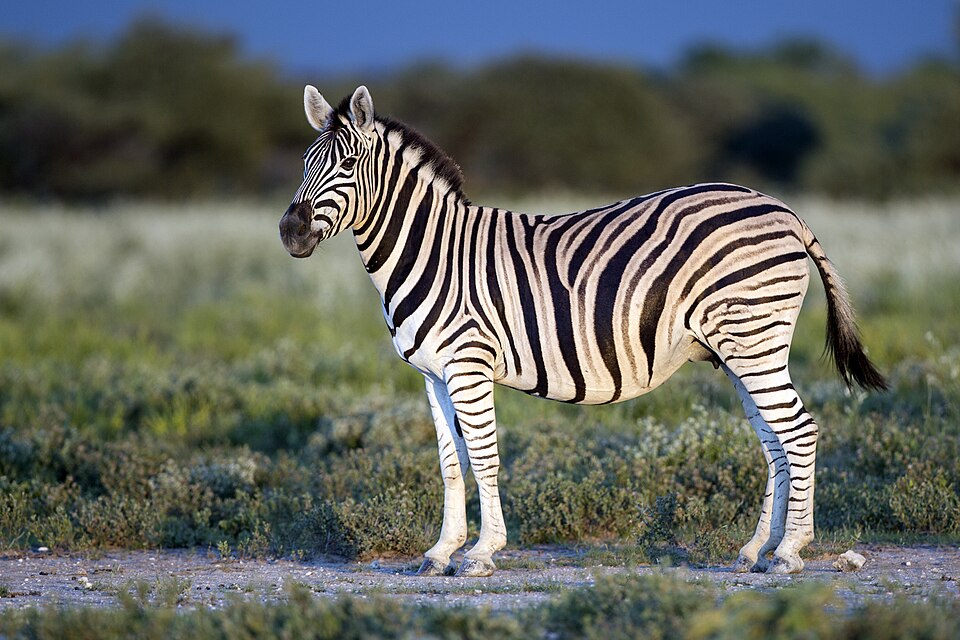
The best supported hypothesis today is that stripes deter biting flies, notably horseflies (tabanids) and tsetse flies: several field experiments show that these insects land significantly less on striped skin than on plain, brown or black skin. Camouflage and thermoregulation remain debated and less supported by current data.
How stripes disturb biting flies
Studies in Kenya and Hungary, using horse mannequins covered in zebra, plain black or white skins, recorded up to about 90% fewer bites on striped patterns compared to black surfaces. The contrast of light/dark bands would disrupt the horsefly's visual perception when it approaches: the polarization of the reflected light would be scrambled, making landing on the skin more difficult and disorienting the insect just before contact.
In the plains zebra, whose coat shows fairly large and well-contrasted stripes on the body, this protection would limit exposure to diseases transmitted by bites, a real issue in the savannahs of East Africa where pressure from tabanids and tsetse flies is high. The hypothesis of camouflage against predators (visual confusion in groups, blurring of contours in front of the lion) has long dominated but is less resistant to testing: observations show that lions identify zebras by smell and noise as much as by sight, including at night when the pattern is not very discriminating. The thermal hypothesis, according to which the strips create refreshing micro-currents of air, also remains weakly confirmed by skin temperature measurements.
A unique pattern per individual
Beyond their supposed function, the stripes form an individual pattern, comparable to a fingerprint: no two plains zebras share exactly the same arrangement of stripes, which allows researchers to identify and track individuals in the field by simple photography, without invasive marking.