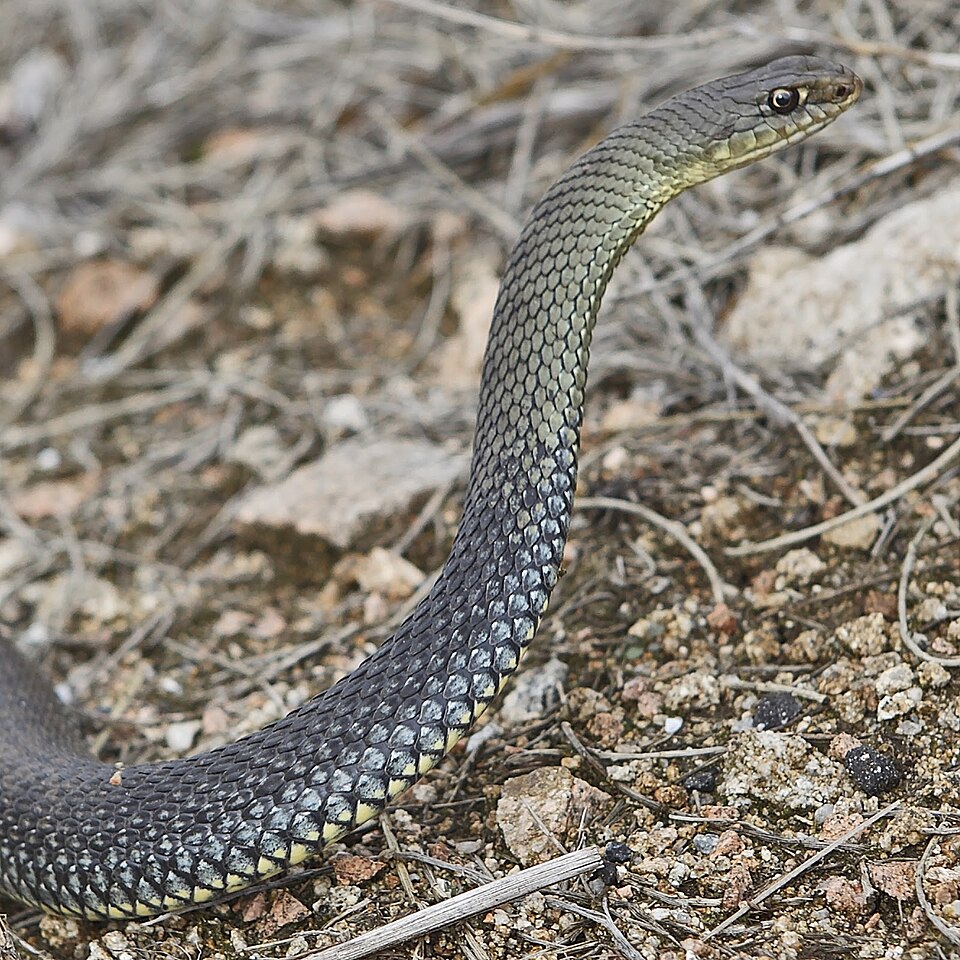
No: the vast majority of snakes are not venomous. Of approximately 3,700 species recorded in the world, only a minority, around 15 to 20%, have an inoculable venom capable of harming humans. The Montpellier Snake, present in Tunisia, illustrates this nuance well: it is venomous but very little dangerous for humans.
Venomous or poisonous: two distinct notions
A venomous animal actively inoculates a toxin, generally by a bite or sting, using a specialized apparatus (hooks, glands). A poisonous animal is only toxic if it is ingested or passively touched, like certain fish or amphibians. These two mechanisms have nothing to do with each other: confusion between the two terms remains very common in everyday language.
The Montpellier snake belongs to the group of opistoglyphic snakes: its venom hooks, short and grooved, are located at the back of the upper jaw, unlike vipers whose hooks are mobile and placed at the front. This venom is primarily used to immobilize its prey, lizards, small mammals or other snakes, and not to defend itself against humans.
Publicité
Publicité
For envenomation to occur in humans, a deep and prolonged bite would be required allowing the venom to reach the tissues via the posterior hooks, a rare situation given the species' evasive behavior. When faced with danger, the Montpellier snake favors flight or intimidation, by raising its head and swelling its neck, rather than biting.
A poorly judged species in Tunisia
In Tunisia, this large snake, which can exceed two meters, is often confused with dangerous snakes because of its impressive size and its spectacular defensive behavior. However, its venom, adapted to small prey, has no significant effect documented on humans in the available literature. Its presence actually helps regulate populations of rodents and lizards in Mediterranean ecosystems.