
Presentation
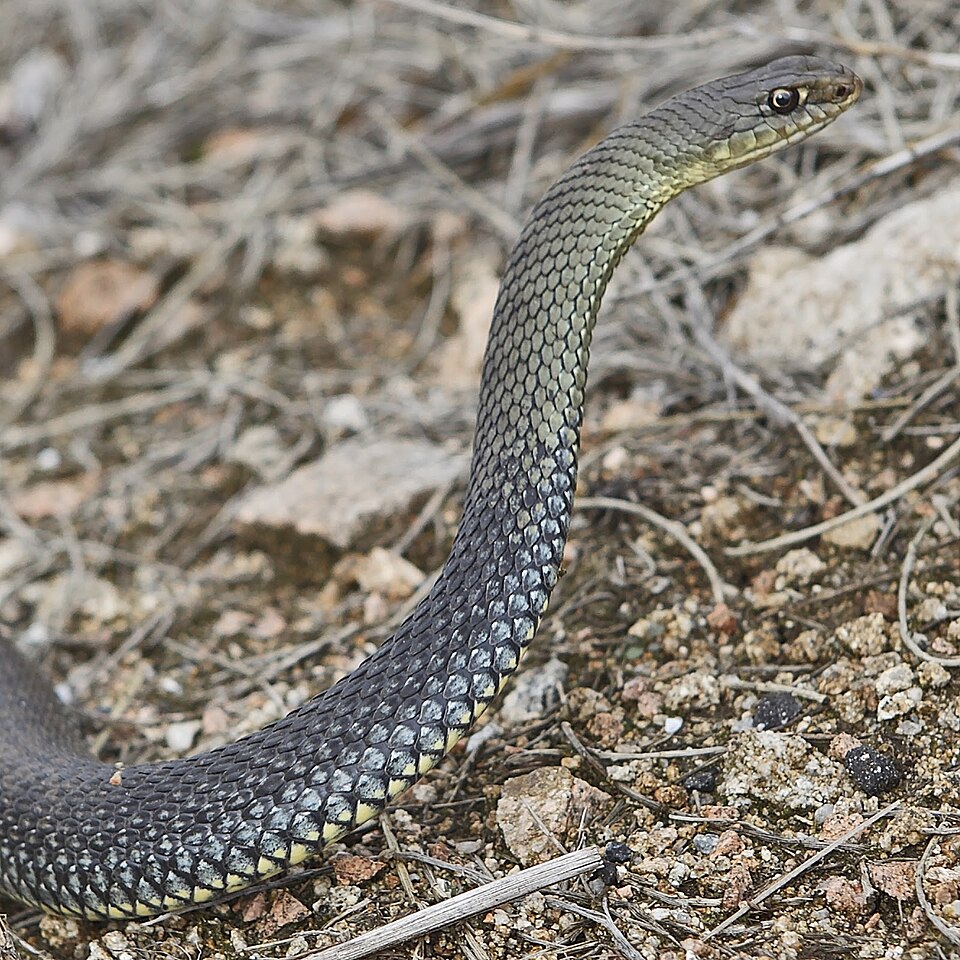
The Montpellier snake is a large opisthoglyphic snake (venomous at the back of the jaw) widespread in the western Mediterranean basin and North Africa. It can be recognized by its elongated head, its large eyes with marked eyebrows giving a “sullen” look, and its brown-gray to olive color, often lighter on the belly. It is one of the largest snakes in Europe and North Africa, capable of exceeding two meters. Active during the day, it hunts by sight and moves quickly in low vegetation and scree. Its bite is not very dangerous for humans, the venom acting mainly on small prey. In Tunisia, it is among the most commonly observed snakes in rural and peri-urban areas.
Slender, muscular body, head distinct from the neck with a rounded muzzle and large eyes topped with protruding arches. The coloring varies from gray-brown to olive green, sometimes with small dark spots arranged in irregular lines in young people, which fade with age. The venomous fangs are located at the back of the upper jaw, which limits the effectiveness of envenomation on humans.
Did you know?
Why do some animals pretend to be dead?
Characteristics
Indicative values: they vary by subspecies, sex and region.
Habitat and distribution
It frequents dry and open environments: scrubland, scrubland, wastelands, scree, wadis and agricultural edges. It is found both in plains and in low mountain areas, and sometimes near homes in rural areas.
CURRENT RANGE
The species is present around the western Mediterranean basin: Iberian Peninsula, southern France, Italy, and North Africa (Morocco, Algeria, Tunisia, Libya). It is widespread and common throughout much of its range.
Behaviour
Diurnal snake, lively and elusive, which favors rapid flight over confrontation when surprised. Faced with a persistent threat, it may rear up, flatten its head and hiss before biting as a last resort. It is a good climber and excellent occasional swimmer, but remains mainly terrestrial, taking refuge under stones, in brush or abandoned burrows.
Reproduction
Mating takes place in spring, after a period of overwintering. The female lays between 4 and 20 eggs in summer, usually in a moist, sheltered place such as a pile of rotting plants or a burrow. Incubation lasts about two months and the young are independent upon hatching.
Peculiarities
Its “browed” appearance due to the bony arches above the eyes is a distinctive characteristic that is easy to recognize in the field. Although it possesses venom, its bite on humans generally causes at most a mild local reaction. It is sometimes confused with vipers because of its size, even though it is completely different.
Threats and conservation
The main threats are the destruction of its natural habitat by urbanization and intensive agriculture, as well as frequent road mortality due to its diurnal movements. It is also sometimes killed through ignorance, being confused with dangerous snakes.
Numbers and trends vary across sources and regions. See the IUCN assessment for the latest reference data.
Gallery
1 documented photographs.
References
Profile updated 17 August 2026 · Reviewed by the TunisieVet editorial team.
Comments (0)
No comments yet.
CONSERVATION STATUS
Least concern (LC)
IUCN source, latest published assessment.
Species health
Documented diseases for this species.
See the 8 diseases of this species Find a veterinarianThis information is provided for educational purposes only and is not a substitute for a veterinary consultation. If you have any concerns about your animal's health, consult a veterinarian.
To discover around: Montpellier snake
Videos, facts, stories and records linked to this species.
Similar animals
Other species documented in Animalpedia.

TunisieVet in your pocket 📱🐾 Access your veterinary services wherever you are. [ Download the app ]
Learn more