More than 60 sheep and goats dead in Gafsa: suspicion of enterotoxemia

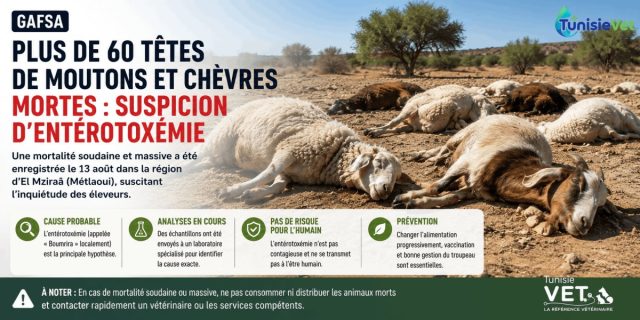
More than 60 sheep and goats dead in Gafsa: suspicion of enterotoxemia
The region of El Mziraâ, falling under the delegation of Métlaoui in the governorate of Gafsa, recorded, Thursday, August 13, a massive and sudden mortality of more than 60 sheep and goats, causing concern among several breeders of the region.
Enterotoxemia, the main hypothesis concerning the death of animals
The head of the agricultural production department at the Regional Agricultural Development Commission (CRDA) of Gafsa, Karem Tlili, indicated that the first findings and autopsies revealed signs compatible with what breeders locally call “Boumrira”, a popular name designating enterotoxemia.
However, he clarified that these findings remain preliminary, pending the results of laboratory analyzes which will make it possible to determine the exact cause of the mortality of the animals.
What are the causes of enterotoxemia in sheep and goats?
Enterotoxemia is a disease that can affect sheep, goats and other ruminants. It can, in certain cases, cause sudden and rapid death.
Among the factors that can favor its appearance include:
- A sudden change in the nature or composition of the diet.
- A rapid transition to concentrated or starch-rich foods.
- A sudden change in the herd's food ration.
- Certain imbalances linked to diet.
Phosphate is it the cause of the death of animals in Gafsa?
Concerning the information indicating a possible link between phosphate and the death of sheep and goats, Karem Tlili indicated that this hypothesis is not confirmed at this stage.
He added that the competent services plan to send samples to a laboratory specializing in the analysis of substances toxic, in order to identify the real cause of mortality.
The Gafsa Regional Agricultural Development Commission is also working in coordination with the general administration of the Ministry of Agriculture in order to identify a laboratory capable of carrying out the analyzes as quickly as possible and obtaining the results quickly.
Is enterotoxemia contagious and can it be transmitted to humans?
The manager confirmed that enterotoxemia is not a contagious disease and is not transmitted to humans. He also ruled out, at this stage, the existence of a general risk for the region's livestock.
The importance of this incident lies mainly in the high number of dead animals and in the fact that the cases were recorded among several breeders in the El Mziraâ region, and not among a single operator.
How to prevent enterotoxemia in sheep?
Good management of the herd’s diet can help reduce the risk of enterotoxemia. Among the main preventive measures:
Gradually change the diet
It is recommended to avoid sudden changes in the type of food, especially when introducing concentrated or starchy foods. The transition must be gradual to allow the animals to adapt.
Preventive vaccination
Preventive vaccination under the supervision of a veterinarian can be an important element of the prevention program, particularly before any significant change in the feed ration.
Monitor the animals and their diet
Daily monitoring of the herd and particular attention to any sudden changes in the appetite, behavior or general condition of the animals allow you to quickly contact a veterinarian in the event of a problem.
Laboratory analyzes will make it possible to determine the cause of mortality
Pending the results of the analyses, enterotoxemia remains a preliminary hypothesis. It is therefore not possible, at this stage, to state that the change in feed, contaminated water or phosphate constitutes the direct cause of the death of the animals.
Laboratory analyzes should make it possible to determine the exact cause of the mortality of more than 60 sheep and goats in the El Mziraâ region and to identify appropriate measures to protect the animals still alive.
Note: in the event of sudden or mass mortality of animals, it is recommended not to consume or distribute dead animals and to quickly contact a veterinarian or the competent veterinary services in order to identify the cause of death and take the necessary measures.
Leave a comment
Be the first to comment on this article.

Be among the first to use our app. Sign up and get early Google Play access.
Discover