
Dental X-Rays for Pets in Tunisia: Cost and When It's Needed

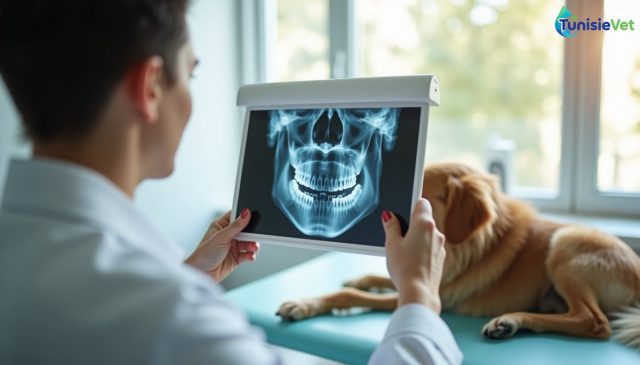
Dental X-rays for pets in Tunisia are increasingly recommended to properly assess the oral health of dogs and cats. Unlike a simple visual check, this imaging technique reveals the tooth roots, the surrounding bone, and the tissue beneath the gumline that are otherwise invisible to the naked eye. Many pet owners wonder how much this exam actually costs and when it truly becomes necessary. This practical guide answers the most common questions to help you plan for this expense.
Why is dental X-ray imaging important?
Most dental problems develop below the gumline, in areas a vet simply cannot see during a routine check-up. That's why detecting dental issues in pets often relies on imaging. X-rays are particularly useful to:
- Spot dental abscesses or fractured roots that aren't visible on clinical exam
- Assess bone loss caused by advanced periodontal disease
- Confirm the presence of impacted or extra teeth, common in certain breeds
- Verify that a root has been fully removed after an extraction
- Detect cysts or suspicious lesions in the jaw
Without this exam, a vet may underestimate how serious a problem really is, or conversely, remove a tooth that could have been saved.
When does a dental X-ray become necessary?
Before or during a dental scaling
The cost of dental scaling for dogs and cats increasingly includes an X-ray check, since scaling alone reveals nothing about what's happening under the gum. This is especially recommended for older pets or those with persistent bad breath despite a recent cleaning.
Before a tooth extraction
Any tooth extraction in pets should ideally be preceded by an X-ray to determine the exact shape of the roots (which can be curved or fused) and to anticipate possible complications. A follow-up X-ray after extraction also confirms that no root fragment has been left behind.
When clinical signs point to a problem
- Pain while chewing or refusing hard kibble
- Facial swelling, particularly under the eye
- Repeated gum bleeding
- A loose or discolored tooth
- A fistula or small hole visible on the gum or skin
Dental X-ray pricing: what makes the cost vary
The price of a dental X-ray depends on several factors specific to each clinic and each case, which explains why costs can differ noticeably from one place to another:
- The type of equipment used: a dedicated digital dental X-ray unit produces sharper images but represents a bigger investment for the clinic, which affects the final price.
- The number of images needed: checking a single suspicious tooth requires far fewer shots than a full-mouth dental assessment.
- The anesthesia involved: dental X-rays almost always require general anesthesia or deep sedation, and this cost is added on top of the imaging itself.
- The region and type of clinic: clinics with advanced equipment, often found in bigger cities, may charge differently than more general practices in rural areas.
- The context of the exam: a standalone X-ray usually costs less than a package combining scaling, X-rays, and a possible extraction under the same anesthesia.
How to manage this cost depending on your region and clinic
To keep pet dental care costs in Tunisia under control, a few simple habits can help you avoid unpleasant surprises:
- Ask for a detailed quote before the procedure, breaking down anesthesia, X-rays, and any additional treatment (scaling, extraction) separately.
- Compare a few clinics when possible, factoring in not just the price but also the equipment available and the vet's experience with dental work.
- Combine procedures: having scaling, X-rays, and a possible extraction done under a single anesthesia reduces the costs tied to repeated sedation.
- Focus on prevention: regular tooth brushing and routine check-ups help prevent advanced conditions that require costly treatment.
- Plan ahead for predisposed breeds: small dog breeds and certain cats are more prone to early dental problems and benefit from closer monitoring.
If your pet has unusual bad breath, seems uncomfortable while chewing, or is simply due for a routine check-up, it's worth consulting veterinarians for dogs or veterinarians for cats to find out whether a dental X-ray is recommended. For other species, the directory of veterinarians in Tunisia can help you find a suitable professional near you.
Is a dental X-ray painful for the animal?
No, the exam itself isn't painful: it's performed under general anesthesia or deep sedation, so the animal feels nothing while the images are taken. This anesthesia, necessary to get clear, motion-free images, is actually one of the main reasons behind the overall cost of the exam.
Leave a comment
Be the first to comment on this article.

TunisieVet in your pocket 📱🐾 Access your veterinary services wherever you are. [ Download the app ]
Learn more