Presentation
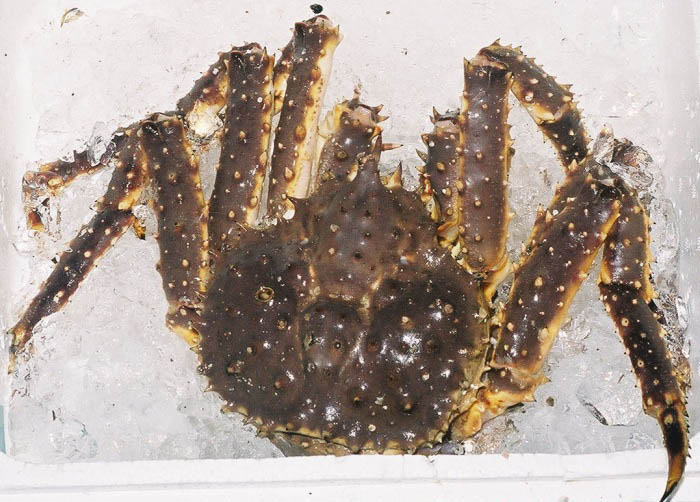
The king crab is a large marine crustacean native to the cold waters of the North Pacific, recognizable by its spiny shell and long legs spread in a fan-like pattern. It actually belongs to the anomuran group, closely related to hermit crabs, although its body shape resembles that of true crabs. The species has been exploited commercially since the mid-twentieth century, particularly in the Bering and Okhotsk seas. It was deliberately introduced to the Barents Sea in the 1960s, where it has since become widely established. Its meat is highly prized in international cuisine, making it a major fishing resource. This crab lives on the sea floor at varying depths depending on the season.
The king crab has a triangular shell covered with spines and three pairs of visible walking legs, the fourth pair being reduced and hidden beneath the shell. Its color ranges from reddish-brown to orange, intensifying when cooked. The leg span can exceed one meter in the largest adult individuals.
Characteristics
Indicative values: they vary by subspecies, sex and region.
Habitat and distribution
The king crab inhabits sandy, rocky, or muddy seafloors, from the littoral zone down to several hundred meters deep. Juveniles prefer shallow waters while adults migrate to greater depths outside the breeding season. It tolerates a wide range of temperatures, which facilitates its geographic expansion.
CURRENT RANGE
The species is native to the North Pacific, particularly the Bering Sea, Sea of Okhotsk, and the coasts of Kamchatka and Alaska. It was introduced to the Barents Sea in the 1960s by the Soviet Union, from where it spread to Norwegian coastal waters. This deliberate introduction makes it a concerning invasive species in the North Atlantic.
Behaviour
This species is rather solitary outside breeding periods, during which it forms large aggregations on shallow coastal sea floors. It undertakes seasonal migrations between deep waters and shallow coastal zones. The king crab is primarily active at night and moves slowly across the marine substrate.
Reproduction
The female carries her fertilized eggs under her abdomen for approximately one year before hatching. Egg-laying occurs in winter, usually in shallow coastal zones. Planktonic larvae pass through several stages before metamorphosing into benthic juveniles.
Peculiarities
The king crab is not a true crab taxonomically but an anomuran, related to hermit crabs. Its introduction to the Barents Sea illustrates a notable case of an invasive species resulting from deliberate introduction, permanently altering local benthic ecosystems. Its impressive size and commercial value make it an emblematic species in Arctic fisheries.
Threats and conservation
In its native range, the species faces intense fishing pressure regulated by quotas. As an invasive species in the North Atlantic, it disrupts local ecosystems by competing with native species and altering benthic communities. Climate change could influence its future distribution.
Numbers and trends vary across sources and regions. See the IUCN assessment for the latest reference data.
Gallery
1 documented photographs.
References
Profile updated 28 August 2026 · Reviewed by the TunisieVet editorial team.
Comments (0)
No comments yet.
CONSERVATION STATUS
Data deficient (DD)
IUCN source, latest published assessment.
Species health
Documented diseases for this species.
This information is provided for educational purposes only and is not a substitute for a veterinary consultation. If you have any concerns about your animal's health, consult a veterinarian.
To discover around: King crab
Videos, facts, stories and records linked to this species.
RECORD
up to 12 kg / 1.5 m leg span
One of the largest crustaceans sold commercially
Measurements taken from adult males captured in North Pacific fisheries.
Similar animals
Other species documented in Animalpedia.

Be among the first to use our app. Sign up and get early Google Play access.
Discover