
Presentation
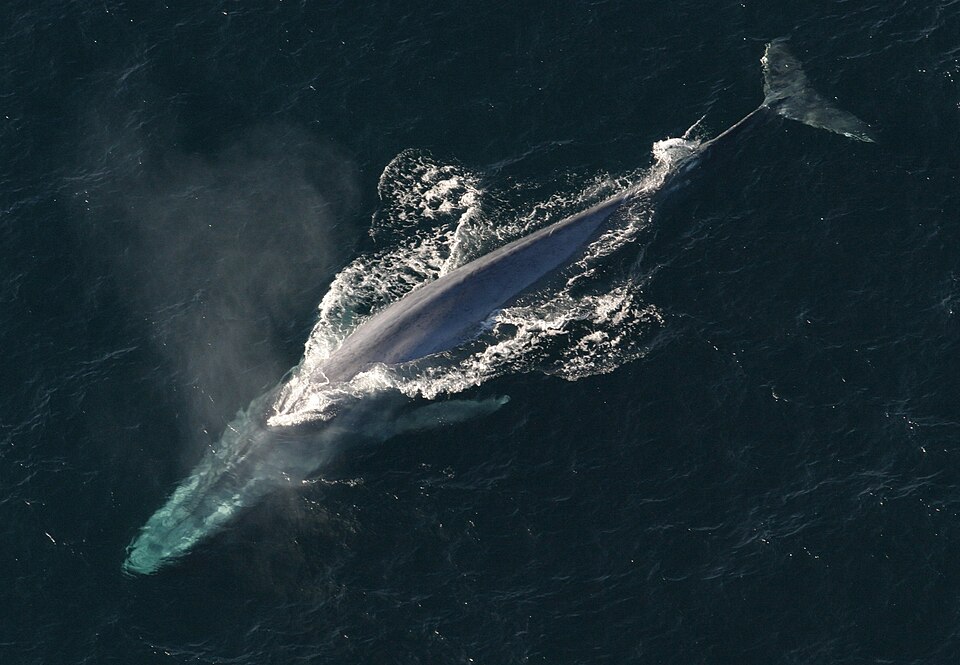
Blue whale is the largest animal to have ever existed on Earth. This majestic cetacean has a slender blue-gray body, paler ventrally, with a massive head making up about a quarter of its total length. Despite its colossal size, it feeds exclusively on tiny marine organisms called krill.
Blue whale has smooth blue-gray skin with lighter shades. Its fusiform body is perfectly adapted to ocean life, with long pectoral fins and a very reduced dorsal fin. It has baleen instead of teeth, lamellar structures that allow it to filter krill from seawater.
Did you know?
Why do whales sing?
Characteristics
Indicative values: they vary by subspecies, sex and region.
Habitat and distribution
Blue whale inhabits the world's oceans, preferring open waters and food-rich coastal areas. It frequents the cold and very productive waters of polar and sub-polar regions to feed, particularly around Antarctica and the Arctic. It migrates to temperate and tropical waters in winter for breeding, although some populations remain in their feeding grounds all year round.
CURRENT RANGE
Blue whale is present in all the world's oceans, with several distinct populations. The main populations are found in the Atlantic Ocean, the Pacific and the Indian Ocean. The greatest concentration is around Antarctica where the most abundant food resources are concentrated. Some populations remained isolated in their respective regions, sometimes developing distinctive traits.
Behaviour
Blue whale is usually solitary or lives in small groups called pods. It is migratory, traveling between feeding areas in cold polar waters and breeding areas in temperate waters. She is an excellent swimmer capable of reaching speeds of 20 km/h while cruising. These giants communicate with each other through very long-range songs and deep calls.
Reproduction
Blue whale reaches sexual maturity around 5 to 15 years old depending on the population. Mating takes place in temperate waters during winter migration periods. After a gestation of around 11 months, the female gives birth to a single calf which weighs around 2 to 3 tonnes at birth. Breastfeeding lasts 6 to 7 months, during which the calf grows rapidly.
Peculiarities
Blue whale holds several remarkable records: it is the heaviest animal ever, the loudest with its calls exceeding 188 decibels, and has the largest heart in nature. Its circulatory system is extraordinary, with an aorta so large that a man could stand in it. Despite its gigantic size, it feeds on tiny creatures, a marvel of adaptation.
Threats and conservation
Blue whale is classified as Endangered by the IUCN. Although commercial hunting has been banned since 1966, this species is still experiencing a slow recovery following massive historical harvests. Contemporary threats include ship strikes, fishing net entanglements, marine pollution, climate change affecting the availability of krill, and underwater noise that interferes with communication.
Numbers and trends vary across sources and regions. See the IUCN assessment for the latest reference data.
Gallery
1 documented photographs.
References
UICN — Liste rouge des espèces menacées
Profile updated 29 August 2026 · Reviewed by the TunisieVet editorial team.
Comments (0)
No comments yet.
CONSERVATION STATUS
Endangered (EN)
IUCN source, latest published assessment.
Species health
Documented diseases for this species.
This information is provided for educational purposes only and is not a substitute for a veterinary consultation. If you have any concerns about your animal's health, consult a veterinarian.
To discover around: Blue whale
Videos, facts, stories and records linked to this species.
Similar animals
Other species documented in Animalpedia.

TunisieVet in your pocket 📱🐾 Access your veterinary services wherever you are. [ Download the app ]
Learn more