
Presentation
The Loggerhead sea turtle is a large sea turtle recognizable by its particularly large head and its reddish-brown shell. It is one of the largest sea turtles today, capable of traveling thousands of kilometers across the world's oceans.
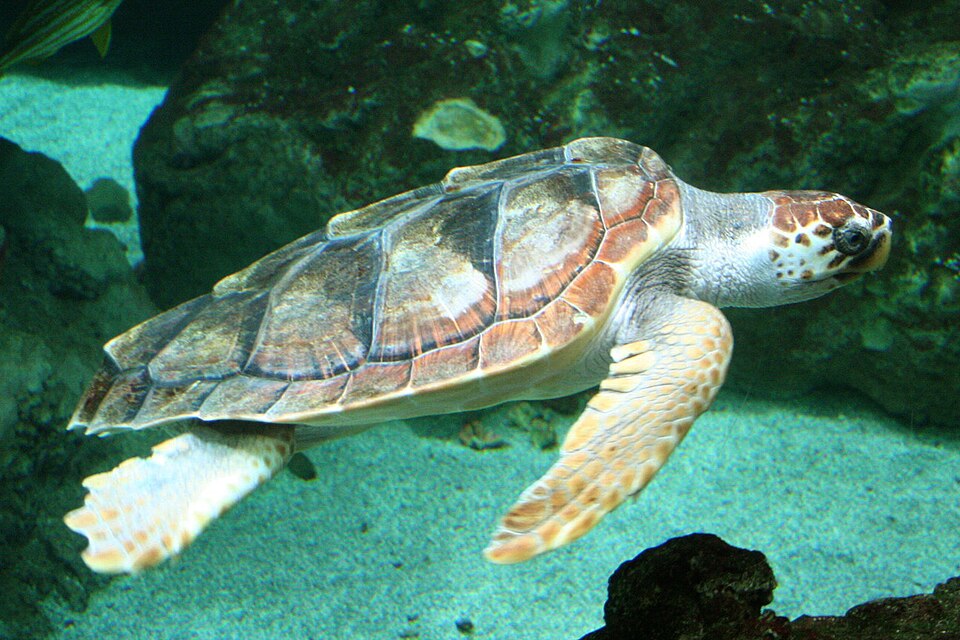
The Loggerhead sea turtle has a slightly convex, ovoid carapace, brown to reddish in color, with a disproportionately large head furnished with powerful jaws. Its four limbs are transformed into flat, tapered fins, suitable for ocean swimming. The skin is usually grayish to dark brown.
Did you know?
How do sea turtles find their birth beach?
Characteristics
Indicative values: they vary by subspecies, sex and region.
Habitat and distribution
Loggerhead sea turtle mainly occupies the pelagic and coastal zones of tropical, subtropical and temperate oceans. It inhabits open waters but approaches coasts and shorelines to feed and reproduce. It also frequents bays, estuaries and transition zones between oceanic and coastal waters.
CURRENT RANGE
The Loggerhead sea turtle has a cosmopolitan distribution. It is found in all the major oceans of the world, both in tropical and subtropical waters and in temperate waters. The North Atlantic, the Mediterranean, the Indian Ocean and the Pacific support significant populations. Migrations lead it to cover entire ocean basins during its existence.
Behaviour
Loggerhead sea turtle is a remarkable ocean swimmer, capable of making long migrations between its feeding and breeding sites. It comes to the surface to breathe regularly and spends much of its time in open water. Although mostly solitary, it can form aggregations during reproduction periods.
Reproduction
Loggerhead sea turtle females return to land, often to the same place where they were born, to lay their eggs in the sand. A female generally lays between 100 and 150 eggs in a nest dug on the beach. Incubation lasts about 7 to 10 weeks, after which the young turtles head to the ocean. Sexual maturity is reached between the ages of 35 and 50.
Peculiarities
The Loggerhead sea turtle has an exceptionally large head, hence its vernacular name. Its chewing muscles are extraordinarily powerful, allowing it to crush hard shells. It is equipped with magnetic sensors which give it remarkable navigation capacity over very long distances. It is also capable of thermoregulation to maintain a body temperature slightly higher than that of the water.
Threats and conservation
The Loggerhead sea turtle faces several major threats. Accidental capture in fishing nets and hooks constitutes significant mortality. Marine pollution, particularly plastic debris that it confuses with natural prey, represents a growing threat. The destruction of nesting beaches by coastal urbanization, climate change affecting breeding sites and egg predation are other major challenges.
Numbers and trends vary across sources and regions. See the IUCN assessment for the latest reference data.
Gallery
1 documented photographs.
References
UICN — Liste rouge des espèces menacées
Profile updated 31 August 2026 · Reviewed by the TunisieVet editorial team.
Comments (0)
No comments yet.
CONSERVATION STATUS
Vulnerable (VU)
IUCN source, latest published assessment.
Species health
Documented diseases for this species.
This information is provided for educational purposes only and is not a substitute for a veterinary consultation. If you have any concerns about your animal's health, consult a veterinarian.
To discover around: Loggerhead sea turtle
Videos, facts, stories and records linked to this species.
Similar animals
Other species documented in Animalpedia.

TunisieVet in your pocket 📱🐾 Access your veterinary services wherever you are. [ Download the app ]
Learn more