Records & extremesDesertSteppeCoastlineFarmland & grasslandsAfricaAsiaEurope
Which animal lives the longest?
58 views · 1 month ago
No animal holds an absolute longevity record valid for the entire animal kingdom: the records depend on the group and the dating method used. Among land turtles, life expectancy commonly exceeds a century, but the Greenland shark and some molluscs can live several centuries.
Three groups, three records
Large land tortoises (Galápagos or Seychelles giant tortoises) are among the longest-lived vertebrates known, with individuals having exceeded 150 years, an age estimated using captivity records kept by zoos or successive owners. The Greenland shark (Somniosus microcephalus) goes much further: carbon-14 dating of the lens of its eye, a structure that is not renewed after birth, suggests a lifespan of several centuries, with sexual maturity only reached around 150 years old. In bivalve molluscs such as certain deep-sea clams, counting the growth streaks of the shell, comparable to that of the rings of a tree, made it possible to estimate an age of several centuries for the oldest individual ever recorded. These three records are therefore based on very different methods – records, isotopic chemistry, growth streaks – whose margin of error varies greatly.
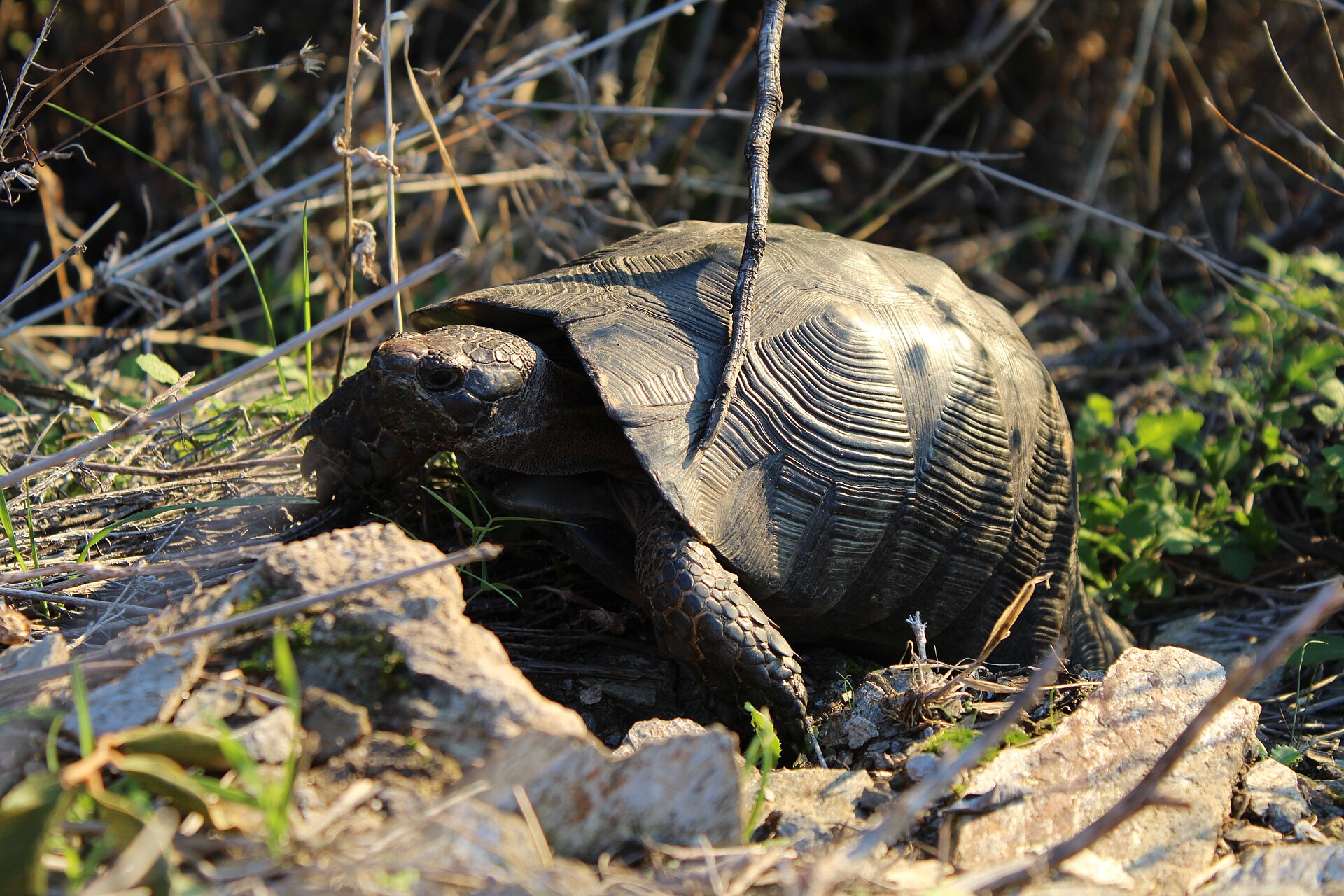
The Greek tortoise (Testudo graeca), present in Tunisia particularly in the Northern and Cap Bon regions, is on a much more modest scale than these absolute records: it commonly lives for several decades, the order of magnitude generally cited being 50 to 80 years in good health, sometimes more.
A concrete consequence for whoever adopts it
This longevity means that adopting a Greek tortoise involves several decades, often beyond an active human life: the animal can change homes several times, which raises the question of its long-term care. The species is also protected by CITES regulations, which strictly regulate its possession and trade; any doubts about his state of health or his needs should be addressed to a veterinarian.