Veterinary case
Severe lameness outbreak in two dairy goat herds
⚠️ This information is provided for awareness only and does not replace an examination by a veterinarian.
🤖 Summary produced automatically from the scientific publication cited at the bottom of the page.
In two dairy goat herds, up to 70% of animals were lame, but the usual footrot bacteria were not to blame.
What happened?
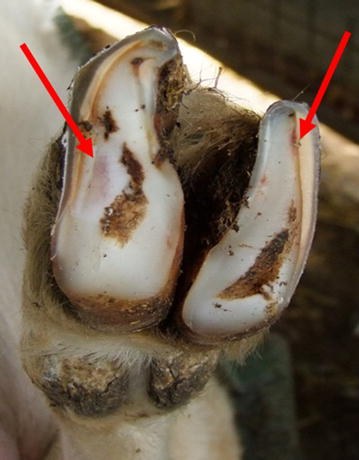
Two dairy goat farms in South West England had struggled for over four years with very high lameness rates, affecting 37% of goats on one farm and 67% on the other. Usual footrot treatments (footbaths, antibiotic spray, copper crystals, antibiotic injections) had not worked. Their vets referred the cases for further investigation.
What did the vet find?
Foot examination revealed lesions ranging from mild bleeding under the horn to extreme cases where only the hoof wall remained, with dead tissue inside. Only one goat had lesions between the claws resembling classic footrot. Swabs were negative for the classic footrot bacteria but positive for bacteria called treponemes, in both sick adults and non-lame youngstock. Rumen pH testing showed some goats had excess acidity, likely linked to a diet too rich in concentrate feed.
What did the vet do?
ℹ️ Treatment given to THIS animal, decided by its veterinarian. It is not a prescription: never apply it without veterinary advice.
Farmers continued trimming and disinfecting hooves with antibiotic spray, sometimes adding copper sulphate crystals under a bandage. Regular footbaths were also used to limit spread. Antibiotic injections used previously had been abandoned as they were considered largely ineffective.
What happened next?
Despite this care, farm staff estimated that fewer than 20% of goats truly recovered. No definite diagnosis could be reached, but vets believe poor-quality hoof horn lesions, partly caused by diet, later become infected with treponemes, making the lameness hard to cure.
Advice for the farmer
To reduce this type of lameness, it is important to monitor diet quality (avoid excess concentrate) and provide suitable flooring and ramps to protect goats' feet.
Source
- Source
- PubMed Central
- Title
- A case report of lameness in two dairy goat herds; a suspected combination of nutritional factors concurrent with treponeme infection.
- Authors
- Groenevelt M, Anzuino K, Smith S, Lee MR, Grogono-Thomas R.
- Year
- 2015
- DOI
- 10.1186/s13104-015-1734-3
- Licence
- CC BY