Veterinary case
A cat dragging its back legs: a spinal bone tumor
⚠️ This information is provided for awareness only and does not replace an examination by a veterinarian.
🤖 Summary produced automatically from the scientific publication cited at the bottom of the page.
A 4-year-old cat struggled more and more to walk because a bone tumor was squeezing its spinal cord.
What happened?
This neutered 5 kg cat had struggled for 3 weeks to walk on its back legs. It refused to jump, often collapsed and had back pain. It also lost 500 g in one week. Painkillers from its vet helped only briefly.
What did the vet find?
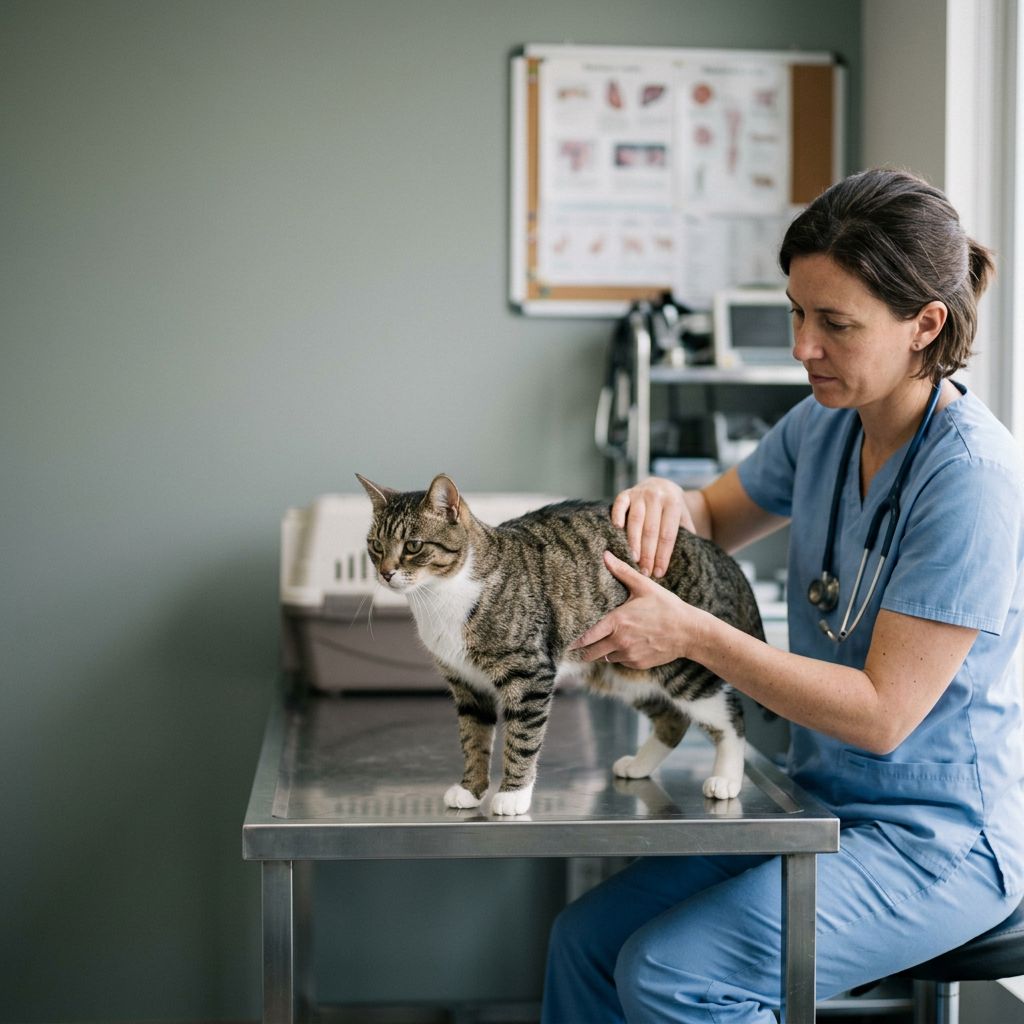
On examination the cat walked with weak, uncoordinated back legs and sometimes fell sideways. Its back was painful. MRI and CT showed a bone mass on a back vertebra squeezing the spinal cord. A needle sample showed abnormal cells, and lab analysis of the removed mass confirmed a rare bone tumor, giant-cell osteosarcoma.
What did the vet do?
ℹ️ Treatment given to THIS animal, decided by its veterinarian. It is not a prescription: never apply it without veterinary advice.
The surgeon opened the back, removed the mass with the affected bone and freed the spinal cord from pressure. The gap was filled with the cat's own fat. The cat received painkillers and went home two days later.
What happened next?
After six weeks the cat was much better, with only mild back-leg incoordination. At six months MRI showed no regrowth. But around one year later the weakness returned and worsened, and the cat was euthanized 373 days after surgery.
Advice for the farmer
If a cat starts limping, refuses to jump or has back pain, see a vet quickly: early action protects the spinal cord.
Source
- Source
- PubMed Central
- Title
- Case Report: Feline spinous process giant-cell osteosarcoma.
- Authors
- Vercoutere DKM, Stee LLV, Weerts EAWS, Meij BP.
- Year
- 2026
- DOI
- 10.3389/fvets.2026.1779067
- Licence
- CC BY