Veterinary case
A show jumping horse returns to competition after tendon injury
⚠️ This information is provided for awareness only and does not replace an examination by a veterinarian.
🤖 Summary produced automatically from the scientific publication cited at the bottom of the page.
After six months without improvement, a show jumping horse recovered thanks to injections of his own cells into the tendon.
What happened?
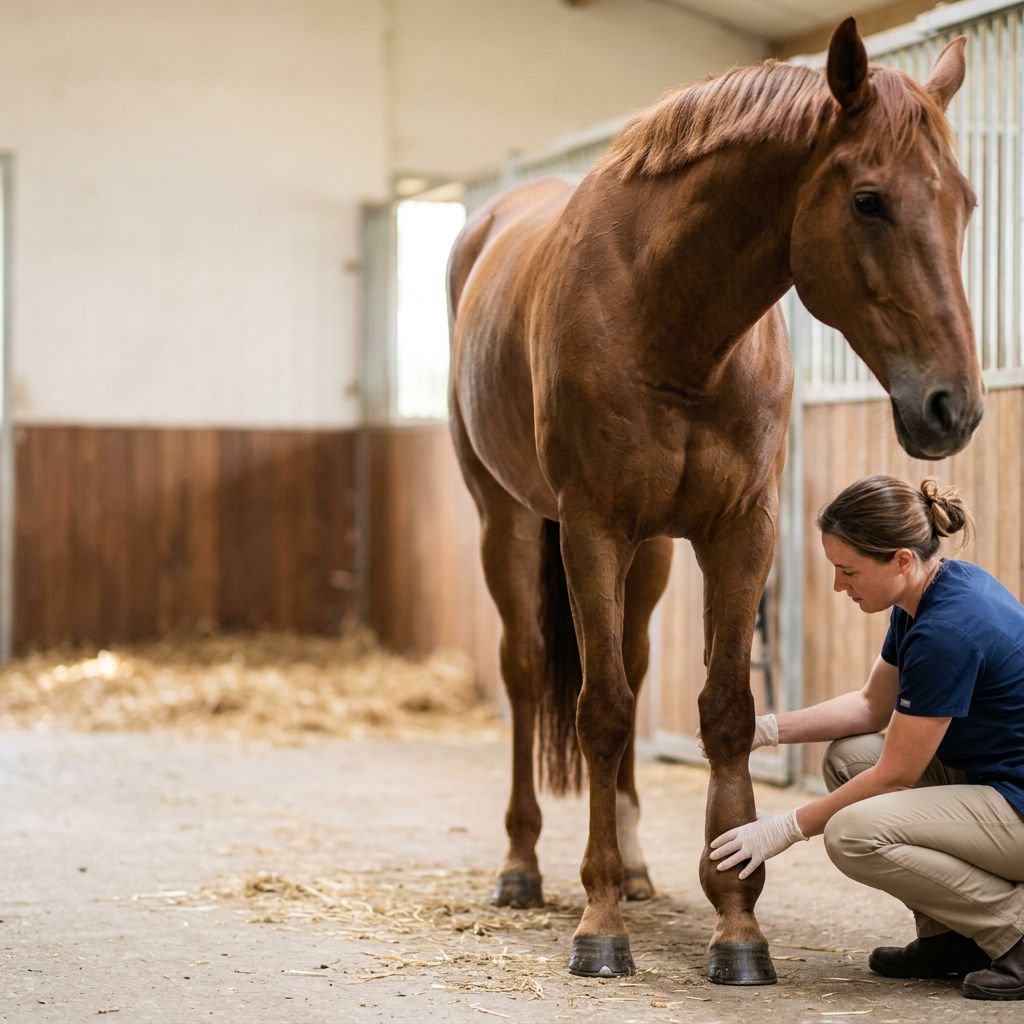
A 10-year-old show jumping gelding was severely lame on the left front leg. The mid-cannon area was swollen, hot and painful. It was a relapse of an old injury that had healed in the same spot. For six months he had stopped competing and received pain relief and controlled rest, with no improvement.
What did the vet find?
The vet found pain, heat and severe swelling on palpation. Ultrasound showed a damaged area in the tendon with disorganized fibers. The diagnosis was chronic inflammation of the superficial digital flexor tendon.
What did the vet do?
ℹ️ Treatment given to THIS animal, decided by its veterinarian. It is not a prescription: never apply it without veterinary advice.
The vet took a little fat from the horse near the base of the tail. In the lab, stem cells were extracted and mixed with the horse's own platelet-rich plasma. The mix was injected straight into the lesion under ultrasound guidance. A second identical injection followed four weeks later, with a protective bandage and rehabilitation.
What happened next?
After four weeks swelling, pain and lameness had decreased. After one year there was no lameness or swelling, and the tendon looked normal on ultrasound. The horse went back to competing and was not re-injured.
Advice for the farmer
If a tendon injury does not improve after months of rest, have the vet re-examine the horse, as these injuries often come back.
Source
- Source
- PubMed Central
- Title
- Case Report: Repeated Intralesional Injections of Autologous Mesenchymal Stem Cells Combined With Platelet-Rich Plasma for Superficial Digital Flexor Tendon Healing in a Show Jumping Horse.
- Authors
- Melotti L, Carolo A, Elshazly N, Boesso F, Da Dalt L, Gabai G, Perazzi A, Iacopetti I, Patruno M.
- Year
- 2022
- DOI
- 10.3389/fvets.2022.843131
- Licence
- CC BY