Veterinary case
A dead dog's teeth reveal the truth about fatherhood
⚠️ This information is provided for awareness only and does not replace an examination by a veterinarian.
🤖 Summary produced automatically from the scientific publication cited at the bottom of the page.
A black-coated sire, a blue dam, and unexpected blue puppies: how do you prove paternity when the father has already died?
What happened?
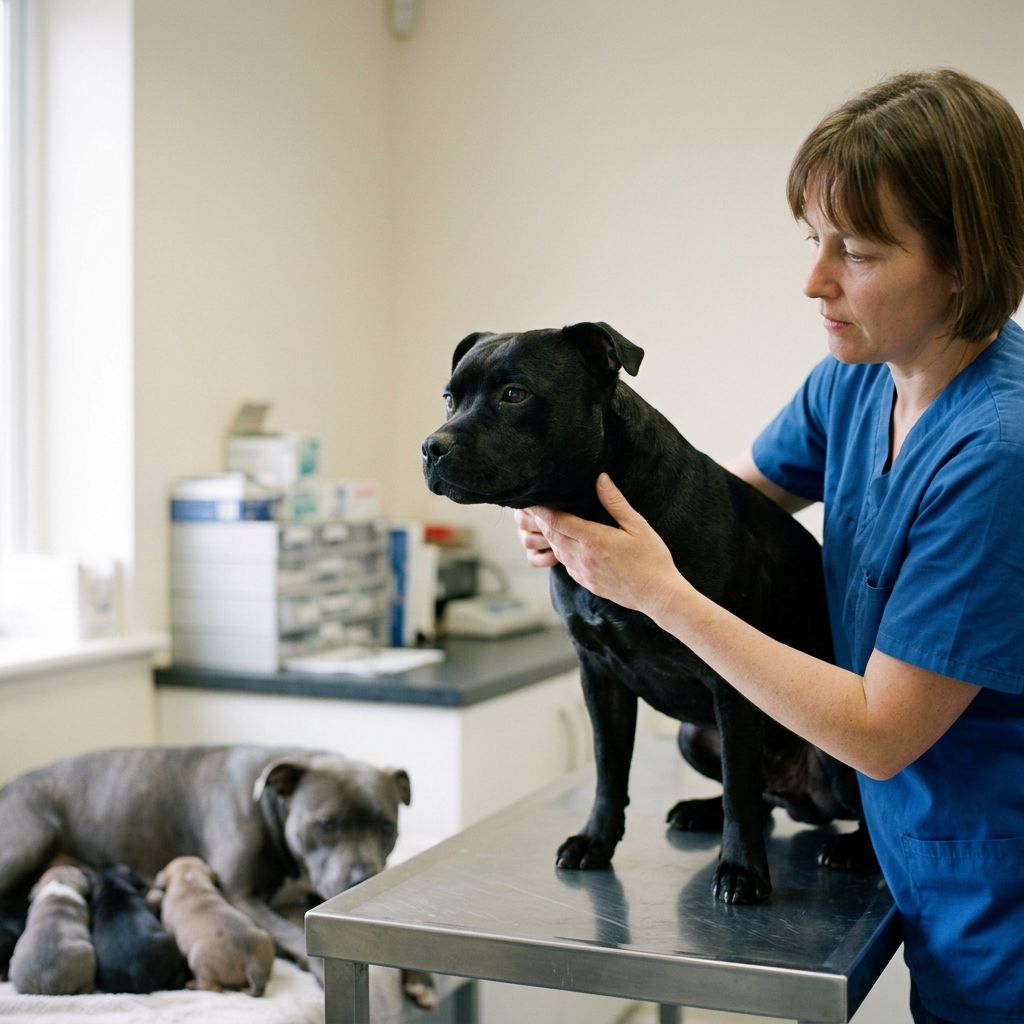
A blue-coated female Staffordshire Bull Terrier was naturally mated with a black-coated male. She gave birth to three blue-coated puppies, an unexpected colour given the father's appearance. The owner requested paternity verification, but before samples could be taken from the father, he died of non-infectious causes. The body was buried in the owner's garden according to regulations, but before burial the official veterinarian extracted two teeth as the only biological trace available.
What did the vet find?
This was not a disease but a genetic investigation: the veterinarian needed to determine whether the deceased dog was indeed the biological father of the blue puppies. Since blood was no longer available, the two extracted teeth were the only usable source of DNA. The laboratory used two different methods to extract DNA from these teeth and compared the results with blood from the mother and puppies.
What did the vet do?
ℹ️ Treatment given to THIS animal, decided by its veterinarian. It is not a prescription: never apply it without veterinary advice.
This was not a medical treatment but a laboratory analysis. The two teeth from the deceased dog were prepared separately: one was sectioned to retrieve dental pulp tissue, the other was decalcified and processed using an automated method. The extracted DNA was then analysed by comparing genetic markers with those of the mother and puppies.
What happened next?
Both methods produced a usable genetic profile from the teeth, although one gave clearer results. In the end, the analysis did not exclude the deceased dog as the biological father of the blue-coated puppies. This case shows that teeth can serve as a reliable source of DNA even after a dog has died and been buried.
Advice for the farmer
For any breeding dog, it is best to carry out a reference DNA test while the animal is alive, to avoid complications if paternity verification becomes necessary after its death.
Source
- Source
- PubMed Central
- Title
- Teeth as a Post-Mortem DNA Source for Forensic Parentage Verification in Dogs: A Case Report.
- Authors
- Floridia V, Capra AP, Bitto M, Oteri G, Cavallo L, Romano C, Femmino A, Rea G, Cianci V, Sapienza D, Liotta L.
- Year
- 2026
- DOI
- 10.3390/vetsci13090948
- Licence
- CC BY