Veterinary case
A dog operated four times for a recurring perineal hernia
⚠️ This information is provided for awareness only and does not replace an examination by a veterinarian.
🤖 Summary produced automatically from the scientific publication cited at the bottom of the page.
After several failed surgeries, this old Pomeranian's bladder had slipped toward the anus: here is how the vets tried to fix it.
What happened?
This 11-year-old castrated Pomeranian had already undergone four surgeries for a perineal hernia on both sides of the anus, without lasting success. Each time, a mass reappeared near the anus and the bladder ended up trapped in that area instead of staying in the abdomen. The dog could no longer urinate normally and was permanently fitted with a urinary catheter. A previous attempt to put the bladder back through the abdomen had failed because of many adhesions, scar tissue stuck together, that prevented freeing it.
What did the vet find?
On arrival, the dog had two firm, non-mobile masses on either side of the anus, with an open wound on the left side and slight bleeding. He could not control his bowel movements. Imaging showed that the bladder was completely displaced into the perineal area, that the urethra (the urine channel) was twisted, and there was mild kidney swelling. The diagnosis was a recurrent bilateral perineal hernia with the bladder trapped in the wrong position, plus a suspected infection in the left wound.
What did the vet do?
ℹ️ Treatment given to THIS animal, decided by its veterinarian. It is not a prescription: never apply it without veterinary advice.
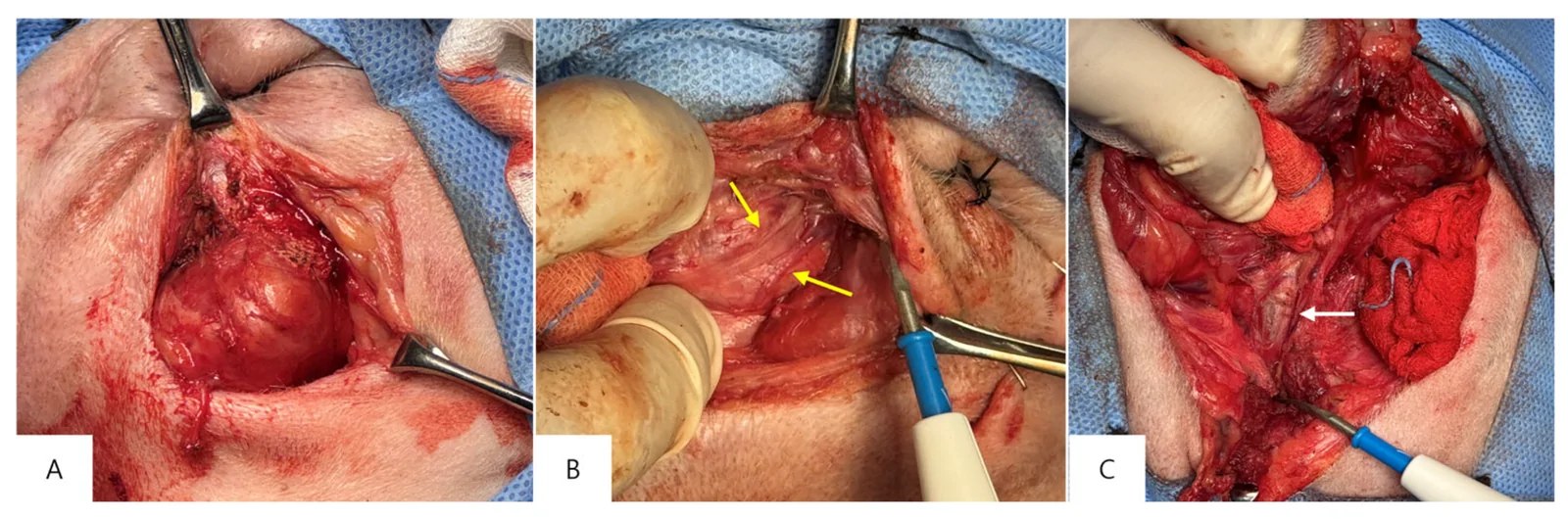
The vets first treated the wound infection with antibiotics for two weeks before the final surgery. During the operation, they first gently freed the bladder, ureters, and urethra from the adhesions through the perineal area, then opened the abdomen to bring the bladder back to its normal position. To stop it slipping back again, they fixed the remaining vas deferens (ducts linked to the reproductive system) to the wall of the rectum, then repaired both sides of the weakened area using the available tissue.
What happened next?
Eight days after surgery, exams showed the bladder and urethra had stayed in the right position, with no new displacement. The dog went home on day nine. A month later he could urinate on his own but still had difficulty and some leakage, and by day 150 his urinary function had improved without becoming fully normal, while his fecal incontinence had clearly improved.
Advice for the farmer
In an older dog, it's best to treat a perineal hernia early and monitor closely after surgery, because repeated recurrences make each new operation much more complicated.
Source
- Source
- PubMed Central
- Title
- Salvage Surgery Including Rectal Wall Vas Deferens Pexy for Recurrent Bilateral Perineal Hernia with Bladder Retroflexion in a Dog: A Case Report.
- Authors
- Park J, Do J, Park C, Yoon S, Eom KD, Kim HY.
- Year
- 2026
- DOI
- 10.3390/vetsci13090969
- Licence
- CC BY