Veterinary case
A bull covered in scabs: what was wrong?
⚠️ This information is provided for awareness only and does not replace an examination by a veterinarian.
🤖 Summary produced automatically from the scientific publication cited at the bottom of the page.
An Ethiopian bull developed crusty, itchy skin all over its body due to a tick-related skin disease.
What happened?
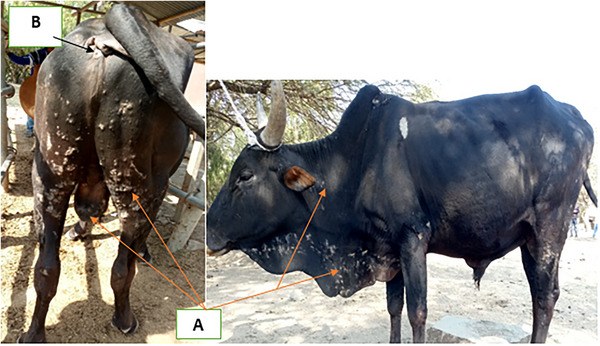
An adult local breed bull was brought to the Debre Markos veterinary clinic because it was eating less and scratching a lot. The owner had noticed dirty scabs appearing on different parts of the body and gradually spreading. The bull also had a few ticks on its skin, especially near the rectal area.
What did the vet find?
The vet observed inflamed, oozing skin with crusts and scales, hair matted into paintbrush-like tufts, and significant itching. Hard, raised wart-like lesions were spread over several body areas. Temperature and other vital signs were normal. Skin samples analyzed in the lab confirmed a bacterium called Dermatophilus congolensis, responsible for this tick-related skin disease.
What did the vet do?
ℹ️ Treatment given to THIS animal, decided by its veterinarian. It is not a prescription: never apply it without veterinary advice.
The vet treated the bull with an antibiotic injected into the muscle to fight the bacteria, and an antiparasitic injected under the skin to kill the ticks. Iodine tincture was also applied directly onto the scabs and skin lesions.
What happened next?
The bull's condition improved gradually with treatment, and it fully recovered within two months.
Advice for the farmer
Regularly check your animals' skin, especially where ticks are present, and treat any suspicious scabs or itching quickly before it spreads.
Source
- Source
- PubMed Central
- Title
- Clinical and Laboratory Diagnosis of Dermatophilosis (Cutaneous Streptothricosis) in Cattle in Ethiopia: Case Report.
- Authors
- Habte D, Addis H, Wondimagegnehu K.
- Year
- 2025
- DOI
- 10.1002/vms3.70245
- Licence
- CC BY