Veterinary case
A rare vascular growth in a cat's neck returns
⚠️ This information is provided for awareness only and does not replace an examination by a veterinarian.
🤖 Summary produced automatically from the scientific publication cited at the bottom of the page.
A young cat became paralyzed in all four limbs after a fall, revealing a rare vascular growth in his neck vertebrae that required two surgeries.
What happened?
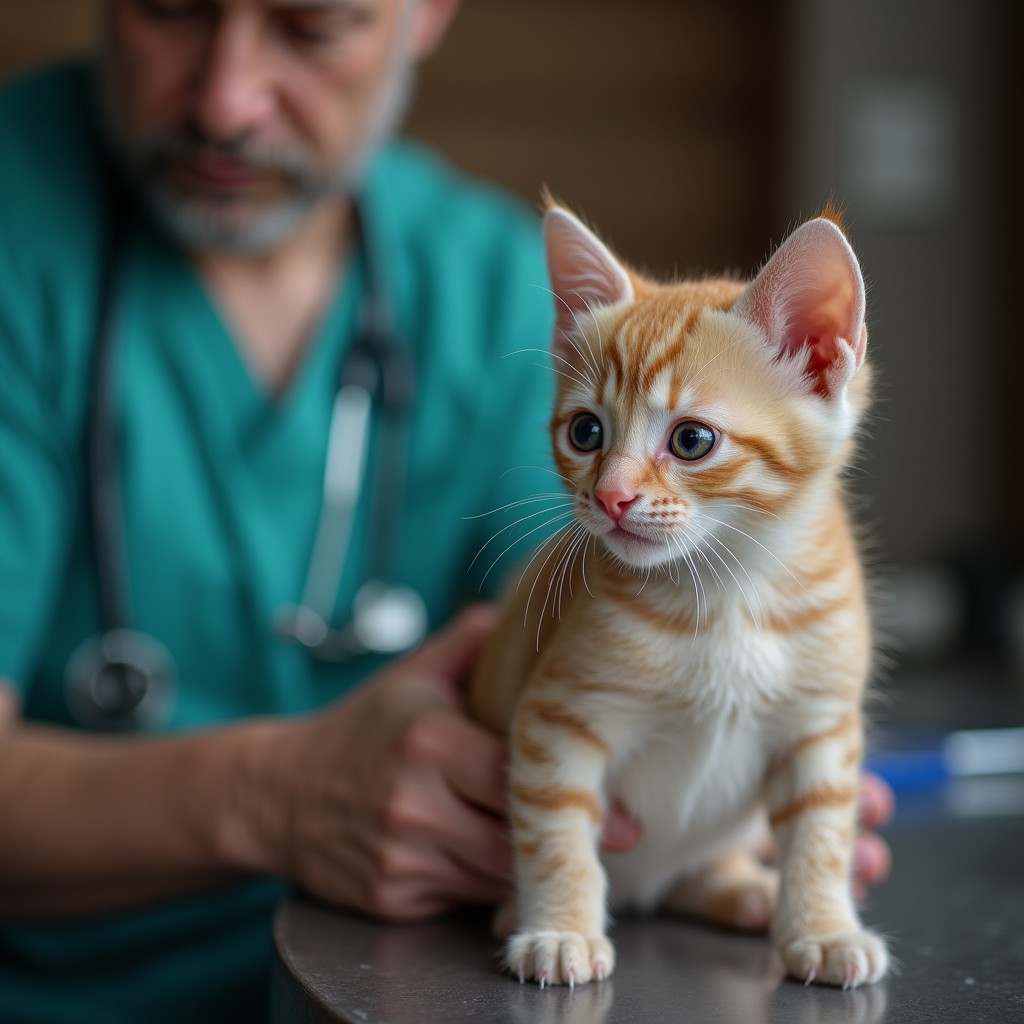
This 3-year-old cat had fallen from a scratching post about a year before being brought to the clinic. Since that fall, he had been walking abnormally and his neck seemed painful, though pain medication had helped somewhat. In the two weeks before the visit, his condition clearly worsened until he could barely walk and cried out in pain.
What did the vet find?
The exam showed weakness in all four legs, worse on the right side, with an unsteady gait and a tendency to fall to the right. MRI and CT scans revealed an abnormal mass attached to a neck vertebra, strongly compressing the spinal cord and pushing it to the left. A biopsy taken during surgery confirmed a vascular hamartoma, a benign mass made of poorly organized small blood vessels that had grown inside the vertebral bone.
What did the vet do?
ℹ️ Treatment given to THIS animal, decided by its veterinarian. It is not a prescription: never apply it without veterinary advice.
The cat underwent surgery to remove part of the diseased bone and free the compressed spinal cord; a piece of fat taken from under his skin was placed to protect the operated area. Because the mass also extended into the front part of the vertebra, it could not be fully removed without risk. After surgery, the cat received pain medication and intensive care, along with physiotherapy. A year later, symptoms returned because the mass had regrown, and the cat underwent a second surgery to remove as much remaining abnormal tissue as possible.
What happened next?
After the first surgery, the cat initially worsened and became completely paralyzed in all four limbs for a few days, then gradually improved with care and physiotherapy until he was walking almost normally again within about two months. After the second surgery, recovery was much faster with no deterioration, and five months later the cat was doing well with only a very mild residual gait issue.
Advice for the farmer
If a young cat shows persistent neck pain or difficulty walking after a fall, it is best to see a vet quickly for detailed imaging, since rare conditions like this type of growth can hide behind what looks like a simple injury.
Source
- Source
- PubMed Central
- Title
- Case Report: Repeated imaging and surgical treatment of a vascular hamartoma arising from the cervical vertebral column of a cat.
- Authors
- Schmitz AK, Buhmann G, Trapp A, Matiasek K, Jurina K.
- Year
- 2026
- DOI
- 10.3389/fvets.2026.1940123
- Licence
- CC BY