
Presentation
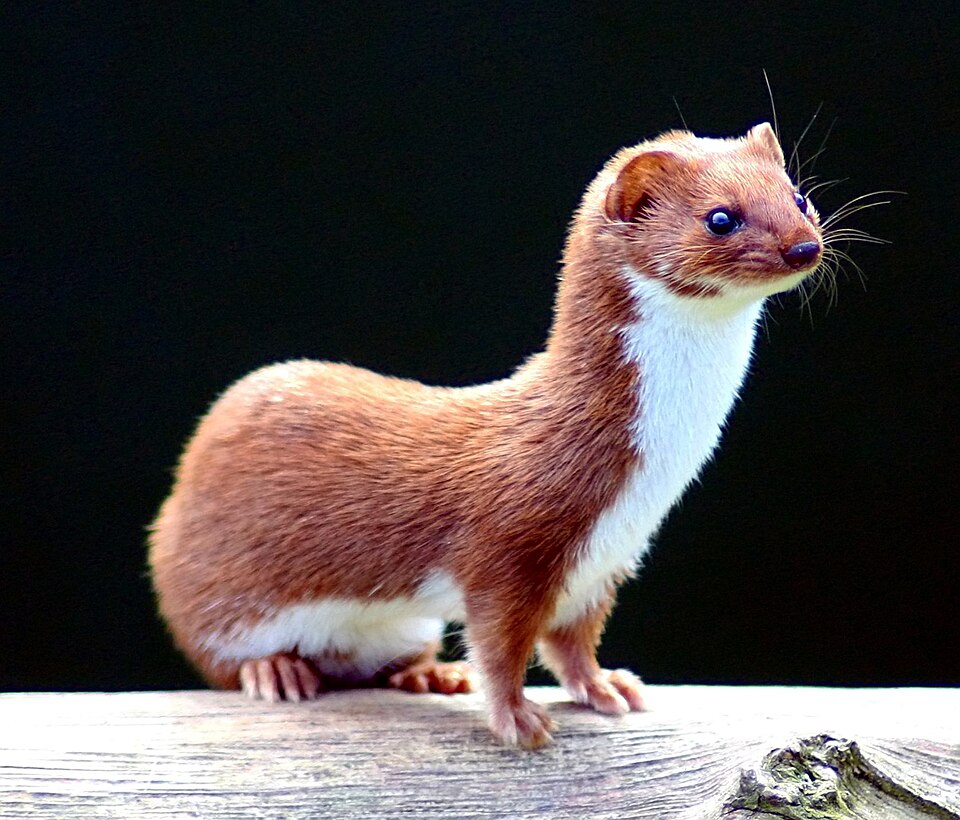
The Weasel (Mustela nivalis) is the world's smallest carnivore, known for its thin, elongated body suitable for hunting in burrows. Discreet and fast, it occupies a wide variety of environments across the northern hemisphere, including North Africa. A voracious predator of small rodents, it plays an important role in regulating vole and mouse populations. Despite its small size, it displays remarkable aggression and agility when facing prey that is sometimes larger than itself. In Tunisia, it is present but remains little observed due to its discreet and nocturnal habits.
The Weasel has a very elongated and flexible body, short legs and a small triangular head. Its coat is reddish-brown above and white underneath, with a clear dividing line between the two colors. Its tail is short, without a black tuft at the end, which distinguishes it from the ermine.
Characteristics
Indicative values: they vary by subspecies, sex and region.
Habitat and distribution
Weasel frequents a wide diversity of environments: meadows, forest edges, cultivated areas and sometimes rocky or semi-arid areas. It favors habitats with dense cover and an abundance of rodents. In Tunisia, it is present in agricultural areas and steppe environments.
CURRENT RANGE
The species is widely distributed in Europe, Asia, North Africa and has been introduced to North America. It is present throughout almost all of Tunisia, from the northern regions to the more arid central areas. Its distribution area makes it one of the most widespread mustelids in the world.
Behaviour
Solitary and territorial, the Weasel is active day and night depending on the availability of prey. It moves in rapid, nervous leaps, exploring every corner of its territory in search of food. It is a courageous animal that does not hesitate to attack prey larger than itself.
Reproduction
The female can have several litters per year if prey is abundant, after a gestation of around 5 weeks. She gives birth to 3 to 6 young, blind and defenseless, in a nest hidden in a burrow or under roots. The young are weaned around 4 to 5 weeks and reach sexual maturity quickly.
Peculiarities
The Weasel is capable of slipping into holes barely larger than its body thanks to its very elongated morphology. She has an extremely fast metabolism which requires her to eat frequently to survive. Unlike the ermine, it does not change color in winter in most of its range.
Threats and conservation
Weasel is not globally threatened and benefits from a wide distribution and good adaptability. Locally, it can suffer from the destruction of its habitat, the use of rodenticides and the scarcity of its prey. It is sometimes persecuted due to ignorance, being confused with pests.
Numbers and trends vary across sources and regions. See the IUCN assessment for the latest reference data.
Gallery
1 documented photographs.
References
Profile updated 26 August 2026 · Reviewed by the TunisieVet editorial team.
Comments (0)
No comments yet.
CONSERVATION STATUS
Least concern (LC)
IUCN source, latest published assessment.
Species health
Documented diseases for this species.
See the 4 diseases of this species Find a veterinarianThis information is provided for educational purposes only and is not a substitute for a veterinary consultation. If you have any concerns about your animal's health, consult a veterinarian.
To discover around: Weasel
Videos, facts, stories and records linked to this species.
RECORD
Approximately 15 to 25 cm of body for 30 to 250 g
The smallest carnivore in the world
Measurement taken on adult individuals, the weasel being the smallest member of the order...
Similar animals
Other species documented in Animalpedia.

TunisieVet in your pocket 📱🐾 Access your veterinary services wherever you are. [ Download the app ]
Learn more