
Presentation
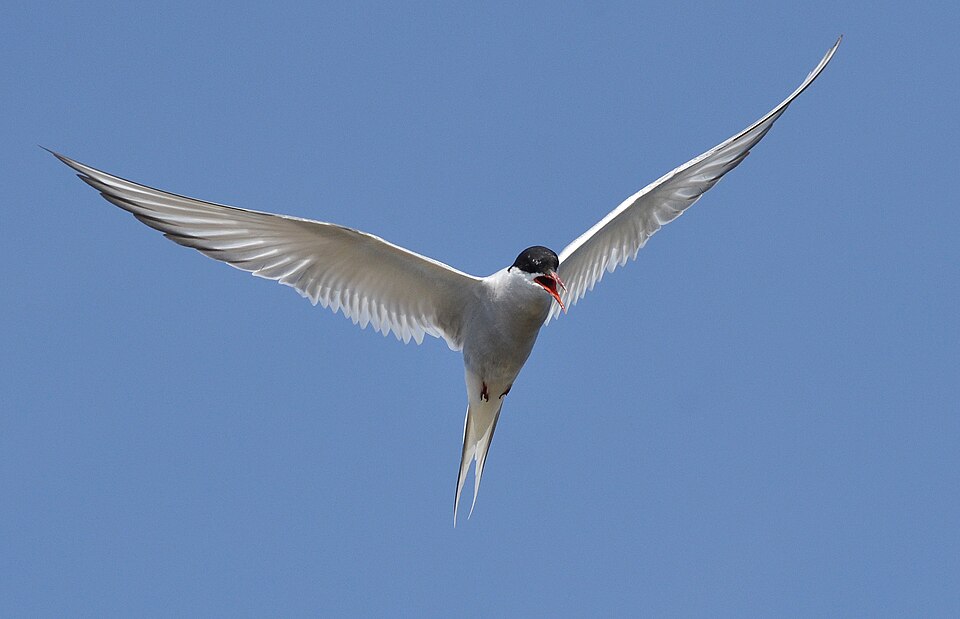
The tern is a medium-sized seabird belonging to the Laridae family, related to gulls and skuas. It is recognised by its slender body, long pointed wings, and often forked tail, along with its predominantly white and pale grey plumage crowned by a black cap. An excellent flier, it hunts by plunge-diving into the water to catch small fish. The term "tern" actually refers to several closely related species of the genus Sterna, some of which breed on the coasts of Tunisia. The bird is renowned for its long migrations and its characteristic piercing call.
Characteristics
Indicative values: they vary by subspecies, sex and region.
Habitat and distribution
Terns frequent coastal shores, estuaries, lagoons and coastal wetland areas where they find both nesting sites and food resources. Some species also venture inland to rivers and lakes. They favour undisturbed locations such as sandy or rocky islets.
CURRENT RANGE
The various tern species have a very wide distribution, present on nearly all continents, notably in Europe, Africa, Asia and the Americas. Many species are migratory and travel long distances between their breeding sites and wintering grounds. In Tunisia, several tern species frequent the coastline, particularly during migration and summer nesting periods.
Behaviour
The tern is a gregarious bird that often nests in dense colonies on beaches, small islands or coastal wetland areas. It is highly territorial near the nest and will dive-bomb intruders, including humans. Lively and acrobatic in flight, it spends much of its time flying over water in search of food.
Reproduction
The tern typically lays two to three eggs directly on the ground in a simple sparsely lined depression. Both parents share incubation duties, which last roughly three to four weeks, and feed the chicks. The young become airborne after a few weeks but remain dependent on the adults for some time.
Peculiarities
Some tern species, such as the Arctic Tern, undertake one of the longest bird migrations known to science, covering tens of thousands of kilometres each year. The breeding plumage with its distinctive black cap appears only during the breeding season. Terns are able to spot a fish from several metres above water before diving with precision.
Threats and conservation
Tern populations are threatened by habitat degradation and loss of coastal wetlands, human disturbance at nesting sites and predation by introduced species. Marine pollution and overfishing affecting small fish resources are also significant threats. Some species benefit from protective measures at their nesting sites.
Numbers and trends vary across sources and regions. See the IUCN assessment for the latest reference data.
Gallery
1 documented photographs.
References
Profile updated 07 September 2026 · Reviewed by the TunisieVet editorial team.
Comments (0)
No comments yet.
CONSERVATION STATUS
Least concern (LC)
IUCN source, latest published assessment.
Species health
Documented diseases for this species.
Find a veterinarianThis information is provided for educational purposes only and is not a substitute for a veterinary consultation. If you have any concerns about your animal's health, consult a veterinarian.
Similar animals
Other species documented in Animalpedia.

TunisieVet in your pocket 📱🐾 Access your veterinary services wherever you are. [ Download the app ]
Learn more