
Presentation
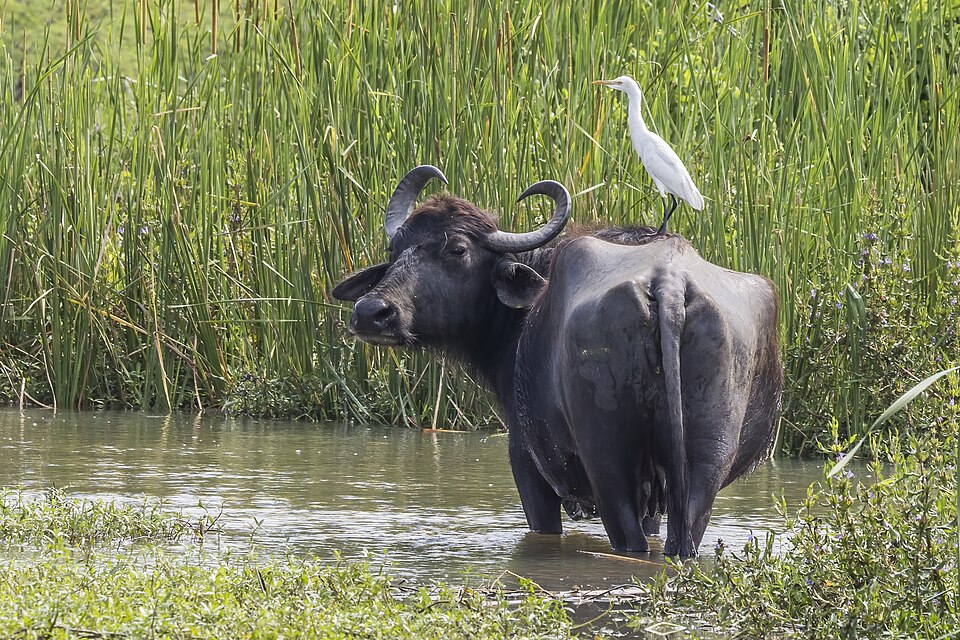
The Water buffalo is a massive bovid domesticated for over 5,000 years, native to the Indian subcontinent. A robust and powerful animal, it is distinguished by its imposing horns and its stocky morphology, perfectly adapted to humid and marshy environments.
The Water buffalo has a thick, muscular body, covered in a generally dark gray to black coat. Its horns, long and curved, can form an imposing crescent. The skin is thick and the temperament generally calm, although the animal is capable of ferocity if provoked.
Characteristics
Indicative values: they vary by subspecies, sex and region.
Habitat and distribution
Water buffalo occupies wetlands, river deltas, marshes and rivers. It actively seeks out bodies of water where it can wallow and quench its thirst. In domestication, it adapts to various humid regions and warm temperate climates, particularly in alluvial valleys.
CURRENT RANGE
Native to the Indian subcontinent, Water buffalo was introduced and spread to Southeast Asia, South Asia, the Middle East, North Africa, and several Mediterranean regions. In Africa, its presence extends from Egypt to the Great Lakes region. Today, it is a widely distributed domestic animal on all continents.
Behaviour
A semi-aquatic animal, the Water buffalo particularly likes flooded areas where it regularly wallows to cool off and protect itself from parasites. Social in nature, it lives in herds and generally remains docile under domestication. Buffalo can become aggressive if they perceive a threat to their herd or offspring.
Reproduction
The Water buffalo reaches sexual maturity around 3 to 4 years old. The rutting period generally occurs between July and December, with a gestation of approximately 10 months. Females give birth to a single calf most of the time, rarely two. Breastfeeding lasts several months.
Peculiarities
The Water buffalo has a remarkable ability to thermoregulate by wallowing in water and mud, which sets it apart from other bovids. Its broad, thick legs, slightly webbed, make it exceptionally suitable for walking in marshy terrain. This gentle but formidable animal can lift considerable loads and is renowned for its strength.
Threats and conservation
As a widely domesticated animal, Water buffalo faces no significant conservation threats. Domestic populations are stable and well managed in most regions.
Numbers and trends vary across sources and regions. See the IUCN assessment for the latest reference data.
Gallery
1 documented photographs.
References
Profile updated 27 August 2026 · Reviewed by the TunisieVet editorial team.
Comments (0)
No comments yet.
CONSERVATION STATUS
Not evaluated (NE)
IUCN source, latest published assessment.
Species health
Documented diseases for this species.
See the 4 diseases of this species Find a veterinarianThis information is provided for educational purposes only and is not a substitute for a veterinary consultation. If you have any concerns about your animal's health, consult a veterinarian.
Related species
To discover around: Water buffalo
Videos, facts, stories and records linked to this species.
Similar animals
Other species documented in Animalpedia.

TunisieVet in your pocket 📱🐾 Access your veterinary services wherever you are. [ Download the app ]
Learn more