
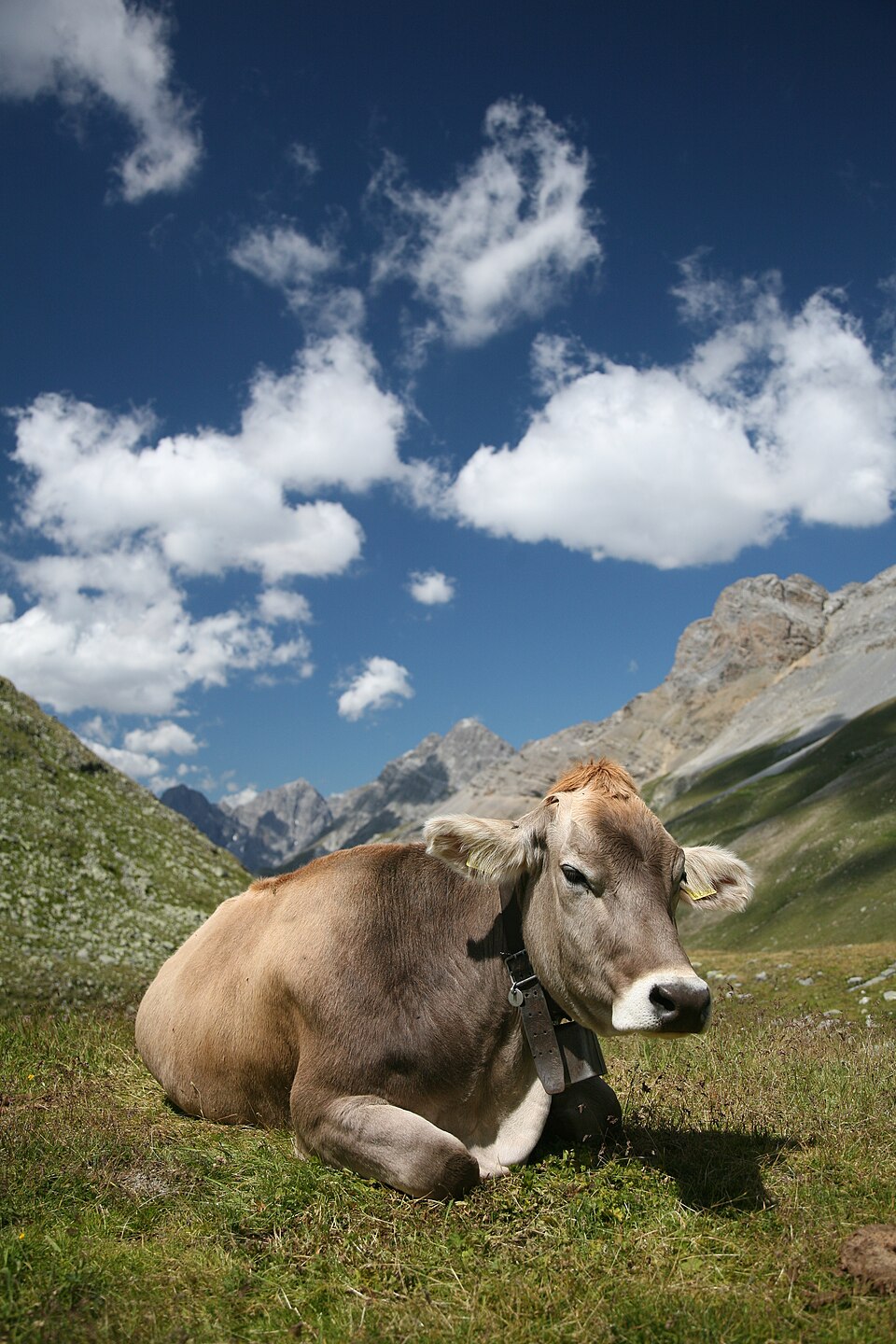
Presentation
The Cow is a large herbivorous mammal domesticated for approximately 10,000 years. Belonging to the Bovidae family, it is one of the most important farm animals in the world, raised primarily for its meat, milk and skin.
The Cow has a massive, stocky body, covered in a coat of short, dense hair. She bears two curved horns, although some breeds are hornless. Its four strong legs support considerable weight, and it has a complex digestive system adapted to its function as a ruminant.
Did you know?
Do bulls hate the color red?
Characteristics
BREEDS
Indicative values: they vary by subspecies, sex and region.
Habitat and distribution
Cow is raised on farms and meadows around the world. It adapts to many climates and altitudes, although temperate, well-grassed areas remain ideal. It needs shelter, quality pastures and access to water for its well-being.
CURRENT RANGE
Cow is present on all continents, from the equator to the polar regions. It is bred in greatest concentration in India, Brazil, the United States, China and Europe. Domestication allowed its global diffusion, regardless of its wild origins in Southwest Asia.
Behaviour
Cows are social and gregarious animals that live in hierarchical herds. They are generally calm and docile, with a remarkable memory. They spend about 8 hours a day grazing and are active especially at dawn and dusk.
Reproduction
Cow reaches sexual maturity around 15 months and can reproduce all year round. The gestation period lasts about 280 days, and the female usually gives birth to a single calf. She produces milk after each birth to breastfeed her young.
Peculiarities
The Cow has excellent spatial memory and recognizes its conspecifics by odors and vocalizations. She can produce up to 25 liters of milk per day depending on her breed and breeding conditions. Its laterally located eyes give it almost 360 degree vision, ideal for detecting predators.
Threats and conservation
As a domestic animal, the Cow is not threatened with extinction. However, certain old and local breeds are becoming rare in the face of the intensification of agriculture and the standardization of industrial breeding.
Numbers and trends vary across sources and regions. See the IUCN assessment for the latest reference data.
Gallery
1 documented photographs.
References
Profile updated 10 August 2026 · Reviewed by the TunisieVet editorial team.
Comments (0)
No comments yet.
CONSERVATION STATUS
Not evaluated (NE)
IUCN source, latest published assessment.
Species health
Documented diseases for this species.
See the 57 diseases of this species Find a veterinarianThis information is provided for educational purposes only and is not a substitute for a veterinary consultation. If you have any concerns about your animal's health, consult a veterinarian.
Related species
Did you know? — Cow
To discover around: Cow
Videos, facts, stories and records linked to this species.
Similar animals
Other species documented in Animalpedia.

TunisieVet in your pocket 📱🐾 Access your veterinary services wherever you are. [ Download the app ]
Learn more