
Presentation
The Ferret is a small domestic carnivore resulting from the domestication of the European polecat. With its elongated, flexible body, short legs and curious temperament, it has become a popular pet for lovers of small carnivores.
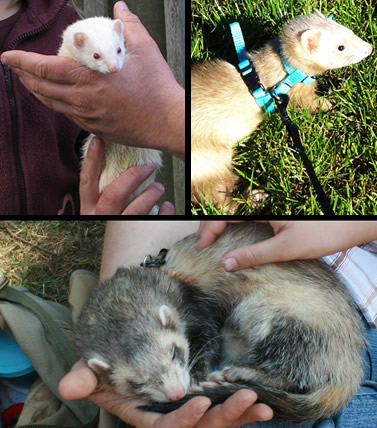
The Ferret has a very elongated and sinuous body, suitable for penetrating burrows. Its coat is dense and soft, usually with a buff or white livery. It has highly developed anal glands which it uses to mark its territory.
Characteristics
Indicative values: they vary by subspecies, sex and region.
Habitat and distribution
The domestic Ferret lives exclusively in urban environments alongside humans. In the natural state, its wild ancestor (the polecat) inhabits semi-open environments, hedges and burrows, but the Ferret selected for domestication has adapted only to the human context.
CURRENT RANGE
The domestic Ferret is now present on all continents (except Antarctica) in urban areas, thanks to its domestication. It does not exist in the wild, but only as a captive-bred pet.
Behaviour
The Ferret is an extremely curious, playful and social animal. He likes to explore his environment and interact with his peers or his owner. He sleeps a lot (up to 18 hours a day) but is very active and turbulent during his waking periods, particularly in the morning and evening.
Reproduction
The domestic Ferret breeds in spring, with a gestation period of approximately 42 days. The female can give birth to 6 to 8 young per litter. Sexual maturity occurs around 4 to 5 months.
Peculiarities
The Ferret has exceptional spine flexibility, which allows it to pass through extremely tight spaces. It is also known for its characteristic musky odor coming from the anal glands, reduced but still noticeable in spayed or neutered individuals.
Threats and conservation
As domestic Ferret faces no significant threats, its status is not assessed by the IUCN. However, escaped Ferrets can become invasive in certain ecosystems, threatening local wildlife.
Numbers and trends vary across sources and regions. See the IUCN assessment for the latest reference data.
Gallery
1 documented photographs.
References
Profile updated 03 September 2026 · Reviewed by the TunisieVet editorial team.
Comments (0)
No comments yet.
CONSERVATION STATUS
Not evaluated (NE)
IUCN source, latest published assessment.
Species health
Documented diseases for this species.
See the 5 diseases of this species Find a veterinarianThis information is provided for educational purposes only and is not a substitute for a veterinary consultation. If you have any concerns about your animal's health, consult a veterinarian.
Related species
To discover around: Ferret
Videos, facts, stories and records linked to this species.
Similar animals
Other species documented in Animalpedia.

TunisieVet in your pocket 📱🐾 Access your veterinary services wherever you are. [ Download the app ]
Learn more