
Presentation
The Ermine (Mustela erminea) is a small carnivorous mustelid found in cold and temperate regions of the northern hemisphere. It is distinguished by its elongated and flexible body, its short legs and its tail ending in a brush of black hairs. Its coat changes color depending on the season, reddish-brown in summer and white in winter in the coldest regions. An agile and fast predator, it mainly hunts small rodents. The species is widespread and does not face any major threats on a global scale.
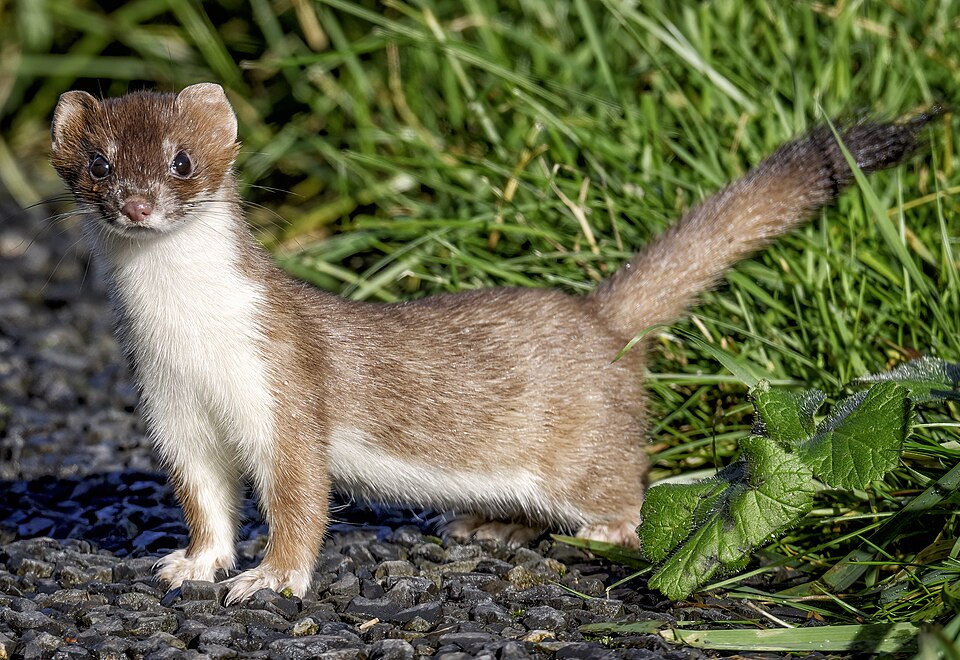
The Ermine has a thin, elongated body, adapted to pursuing prey in burrows. Its coat is reddish-brown on the back and white on the belly in summer, then becomes entirely white in winter, with the exception of the tip of the tail which remains black all year round. Its legs are short and have sharp claws making it easier to run and climb. The ears are small and rounded, and the eyes black and lively.
Characteristics
Indicative values: they vary by subspecies, sex and region.
Habitat and distribution
The Ermine frequents a wide diversity of environments: forests, meadows, wetlands, heaths and mountains. It particularly likes habitats offering hiding places such as hedges, stone walls and bushes. It also adapts to agricultural areas and sometimes around rural homes.
CURRENT RANGE
The species occurs naturally in North America, Europe and northern Asia, in temperate to cold regions. It has also been introduced to New Zealand where it is considered harmful to local wildlife. It is absent from Africa and is not present in Tunisia.
Behaviour
The Ermine is a solitary and territorial animal, active day and night. She is an excellent swimmer and climber, and moves in rapid, flexible leaps. Curious and lively, it actively explores its territory in search of prey. It marks its territory using odorous secretions.
Reproduction
The female gives birth to one litter per year, generally 4 to 9 young, after a gestation including an embryonic diapause phase which can last several months. The young are born blind and dependent, in a nest made in a burrow or cavity. Weaning occurs around 5 to 6 weeks, and sexual maturity is reached quickly in females. Mating takes place in summer, but delayed implantation shifts births to the following spring.
Peculiarities
The change in coat color depending on the season, called chromatic molting, is a remarkable characteristic of the species, especially marked in regions with snowy winters. The black tip of the tail remains visible even in white coat, which could distract the attention of aerial predators. The fur name “Ermine”, historically associated with royal clothing, comes from this white winter molt.
Threats and conservation
The species is not globally threatened and benefits from a very large distribution area. Locally, it can be affected by the destruction of hedges and bocage habitats, as well as by trapping linked to its historical status as a predator of poultry. Climate change, by reducing snow cover, could reduce the effectiveness of winter camouflage in certain regions.
Numbers and trends vary across sources and regions. See the IUCN assessment for the latest reference data.
Gallery
1 documented photographs.
References
Profile updated 23 August 2026 · Reviewed by the TunisieVet editorial team.
Comments (0)
No comments yet.
CONSERVATION STATUS
Least concern (LC)
IUCN source, latest published assessment.
Species health
Documented diseases for this species.
See the 7 diseases of this species Find a veterinarianThis information is provided for educational purposes only and is not a substitute for a veterinary consultation. If you have any concerns about your animal's health, consult a veterinarian.
To discover around: Ermine
Videos, facts, stories and records linked to this species.
Similar animals
Other species documented in Animalpedia.

TunisieVet in your pocket 📱🐾 Access your veterinary services wherever you are. [ Download the app ]
Learn more