
Presentation
The Mink is a small, semi-aquatic carnivorous mammal belonging to the Mustelidae family. There are mainly the European Mink (Mustela lutreola) and the American Mink (NeoMink Mink), the latter being widely bred for its fur and introduced into the wild on several continents. It has an elongated, flexible body, dense, waterproof fur, and partially webbed feet suitable for swimming. It frequents the edges of rivers, lakes and wetlands where it hunts various small animals. The European species is now threatened, while the American Mink, escaped from farms, has become invasive in several regions.
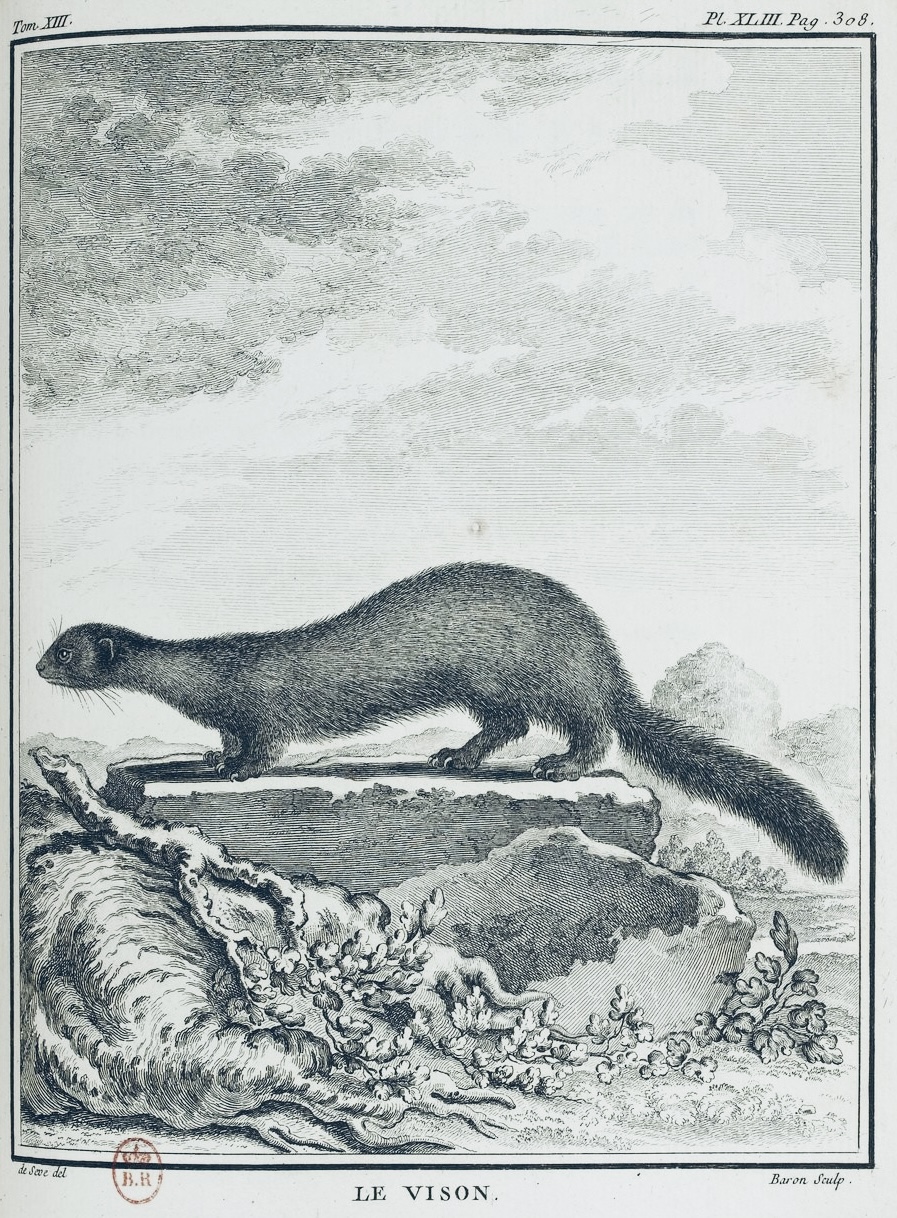
The Mink has a thin, elongated body, short legs and a bushy tail. Its fur, brown to black depending on the individual, is thick and waterproof, which makes it a sought-after species for furs. Its slightly webbed feet and hydrodynamic body make swimming and diving easier.
Characteristics
Indicative values: they vary by subspecies, sex and region.
Habitat and distribution
The Mink lives in the immediate vicinity of rivers, lakes, marshes and wetlands, where it finds both shelter and food. It digs or occupies burrows along banks, often hidden under roots or rocks. The presence of clean, fish-rich water is essential to its maintenance.
CURRENT RANGE
The European Mink occupies residual and fragmented populations in France, Spain and some Eastern European countries. The American Mink is native to North America but was introduced to Europe and Asia via fur farms, where it became established in the wild. The species is not present in Tunisia.
Behaviour
The Mink is a solitary and territorial animal, active mainly at dusk and night. It marks its territory with odorous secretions produced by anal glands. An excellent swimmer and diver, he moves both on land and in water to hunt.
Reproduction
The female gives birth once a year, after a gestation of approximately one month to one and a half months depending on the species. The litter generally numbers between three and seven young, who are born blind and dependent on their mother. The young become independent after a few months and reach sexual maturity around a year old.
Peculiarities
The Mink from America introduced into Europe enters into direct competition with the Mink from Europe, contributing to its decline. The fur of the Mink has been and remains highly prized in the textile industry, which has led to its intensive breeding. Its powerful scent glands are reminiscent of those of other mustelids such as the skunk.
Threats and conservation
The European Mink is threatened by the destruction of wetlands, the pollution of waterways and competition with the introduced American Mink. Trapping and road collisions also exacerbate population declines. Conservation programs exist in several European countries.
Numbers and trends vary across sources and regions. See the IUCN assessment for the latest reference data.
Gallery
1 documented photographs.
References
Profile updated 26 August 2026 · Reviewed by the TunisieVet editorial team.
Comments (0)
No comments yet.
CONSERVATION STATUS
Endangered (EN)
IUCN source, latest published assessment.
Species health
Documented diseases for this species.
Find a veterinarianThis information is provided for educational purposes only and is not a substitute for a veterinary consultation. If you have any concerns about your animal's health, consult a veterinarian.
Similar animals
Other species documented in Animalpedia.
