
Presentation
The Mongolian gerbil is a small domesticated rodent native to the steppes of Central Asia. This active and curious animal has a distinctive tail and soft coat, making it a popular pet around the world.
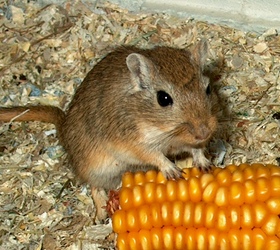
Mongolian gerbil has a slender, elongated body covered in thick gray-brown fur. Its black eyes are large and slightly prominent, while its ears are moderate in size. The tail, almost as long as the body, is covered with short hairs and ends in a distinct tuft.
Characteristics
Indicative values: they vary by subspecies, sex and region.
Habitat and distribution
Mongolian gerbil lives naturally in the deserts and steppes of Central Asia, where it digs complex underground burrows to protect itself from extreme conditions. It prefers dry areas with sparse vegetation and creates burrows with several chambers and escape galleries.
CURRENT RANGE
Mongolian gerbil is native to Mongolia and adjacent areas of northern China. Although it is not naturally present in Tunisia, it is today distributed worldwide thanks to its domestication and its status as a pet in many countries in North Africa and the Middle East.
Behaviour
The Mongolian gerbil is a very active and social animal, particularly during the night and dawn. She is curious, playful and loves digging and exploring her environment. In groups, it establishes a social hierarchy and builds complex burrows. It is a domesticated animal that tolerates handling well when raised young.
Reproduction
Mongolian gerbil reaches sexual maturity around 10-12 weeks. The gestation period lasts approximately 24 days, and a female can give birth to 3-8 young per litter. It is polyestrous and can reproduce several times a year in optimal conditions. The young are breastfed for 3-4 weeks before weaning.
Peculiarities
Mongolian gerbil has several remarkable adaptations: its elongated rear feet allow it to jump up to 30 cm high, and its molars continually grow throughout its life. It uses its tail as a balancer during its jumps and as a means of communication with its peers. Its urinary system is very efficient, producing highly concentrated urine to conserve water.
Threats and conservation
Mongolian gerbil is not threatened in the wild. Its conservation status is classified as Least Concern by the IUCN, because it has a large distribution area and its populations are stable in its natural habitats.
Numbers and trends vary across sources and regions. See the IUCN assessment for the latest reference data.
Gallery
1 documented photographs.
References
UICN — Liste rouge des espèces menacées
Profile updated 17 August 2026 · Reviewed by the TunisieVet editorial team.
Comments (0)
No comments yet.
CONSERVATION STATUS
Least concern (LC)
IUCN source, latest published assessment.
Species health
Documented diseases for this species.
See the 8 diseases of this species Find a veterinarianThis information is provided for educational purposes only and is not a substitute for a veterinary consultation. If you have any concerns about your animal's health, consult a veterinarian.
Similar animals
Other species documented in Animalpedia.

TunisieVet in your pocket 📱🐾 Access your veterinary services wherever you are. [ Download the app ]
Learn more