
Presentation
The donkey is a domestic mammal belonging to the equine family, characterized by its long ears, its generally gray or brown coat, and its small size compared to the horse. Formerly called “donkey”, it is one of the oldest working animals domesticated by man, used for several millennia in agriculture and for transport.
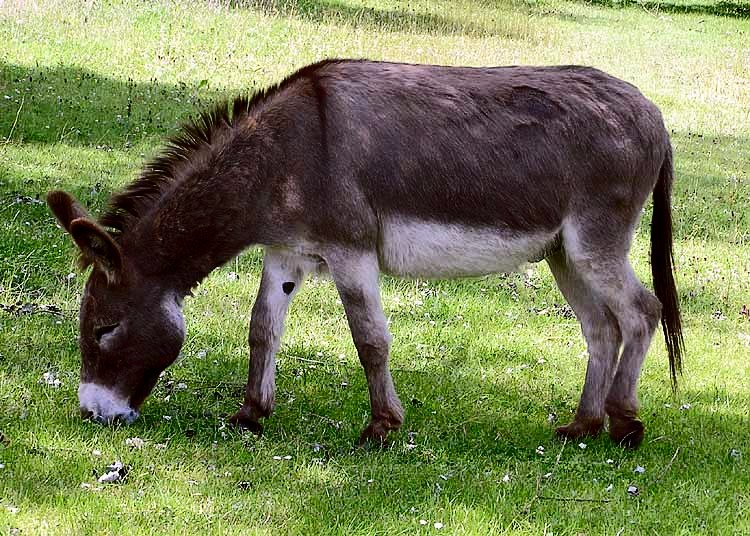
The donkey has long, movable ears, a short, erect mane, and a tail ending in a plume of long hair. Its body is robust and compact, with short and muscular limbs. Its coat varies from gray to brown, often with a dark dorsal stripe and stripes on the front legs.
Characteristics
Indicative values: they vary by subspecies, sex and region.
Habitat and distribution
The donkey is an extremely adaptable animal that thrives in steppes, semi-arid regions and cultivated areas. It adapts well to farms and meadows, supporting rocky terrain and difficult climatic conditions. Its original habitat is the Sahara region and the Middle East.
CURRENT RANGE
The donkey is present on all continents, with the exception of Antarctica. Its worldwide distribution is the result of domestication and systematic breeding by humans. It is found in large numbers in North Africa, West Africa, South Asia and the Middle East, where it remains an essential working animal.
Behaviour
The donkey is a social and intelligent animal, often described as opinionated or stubborn, although this reputation is partly due to its instinct for self-preservation and natural caution. He has an excellent memory and great endurance. Generally peaceful, he can be recalcitrant in the face of dangerous conditions.
Reproduction
The gestation period in donkeys lasts approximately 12 to 14 months, which is longer than in horses. Females generally give birth to only one young per year. The donkey reaches sexual maturity around 2 to 3 years of age and can reproduce until an advanced age.
Peculiarities
The donkey has exceptional resistance to disease and a remarkable ability to survive on little water. Its characteristic call, braying, is very distinctive and audible from great distances. It also has a great spatial memory and can remember paths taken years ago, which has made it valuable for mountain transportation.
Threats and conservation
The domestic donkey is not threatened as a species, its status not being assessed by the IUCN. However, local populations of wild or sub-Saharan donkeys face challenges related to habitat changes and competition with domestic livestock.
Numbers and trends vary across sources and regions. See the IUCN assessment for the latest reference data.
Gallery
1 documented photographs.
References
Profile updated 03 September 2026 · Reviewed by the TunisieVet editorial team.
Comments (0)
No comments yet.
CONSERVATION STATUS
Not evaluated (NE)
IUCN source, latest published assessment.
Species health
Documented diseases for this species.
See the 4 diseases of this species Find a veterinarianThis information is provided for educational purposes only and is not a substitute for a veterinary consultation. If you have any concerns about your animal's health, consult a veterinarian.
Related species
To discover around: Donkey
Videos, facts, stories and records linked to this species.
Similar animals
Other species documented in Animalpedia.

TunisieVet in your pocket 📱🐾 Access your veterinary services wherever you are. [ Download the app ]
Learn more