
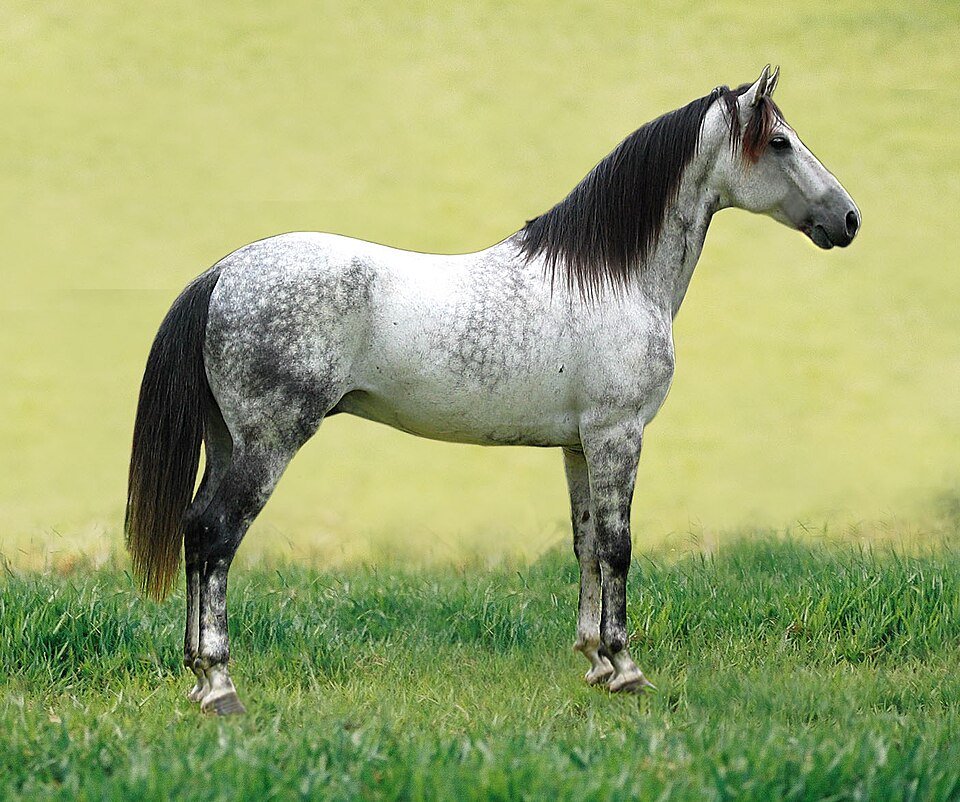
Presentation
The Horse is a large domestic herbivorous mammal belonging to the equidae family. A noble and powerful animal, it was domesticated by humans around 6,000 years ago and remains one of the most culturally and economically important animals around the world.
The Horse has a powerful, slender body, with a distinctive mane and a long, abundant tail. It has four robust limbs ending in a single hoof, large and expressive eyes, and very mobile pointed ears which allow it to localize sounds.
Did you know?
Why do horses sleep standing up?
Characteristics
BREEDS
Indicative values: they vary by subspecies, sex and region.
Habitat and distribution
The domestic Horse adapts to various habitats: it lives in grassy meadows, steppes, agricultural areas and in human-managed environments such as farms and stables. It prefers areas where fresh water is accessible and where it can find abundant food.
CURRENT RANGE
Originally from Central Asia, the Horse was domesticated and is now found on every continent except Antarctica. Its current distribution depends entirely on areas of human breeding. Various breeds have been developed to adapt to very different climates.
Behaviour
The Horse is a social and gregarious animal that naturally lives in herds. Intelligent and sensitive, he has an excellent memory and great reactivity to external stimuli. He is a fast runner capable of fleeing from danger, with highly developed peripheral vision which makes him aware of his surroundings.
Reproduction
The mare reaches sexual maturity around 2-3 years old. Gestation lasts about 11 months and the mare usually gives birth to a single foal in the spring. The foal is breastfed for 6 to 12 months before being weaned gradually.
Peculiarities
The Horse has an exceptional panoramic view with a viewing angle approaching 350°, allowing it to detect threats from almost any side. It communicates through distinctive neighs, various noises and rich body language based on the position of the ears and tail. His teeth continue to grow throughout his life.
Threats and conservation
As a domestic animal, the Horse is not threatened as a species. However, individual well-being can be affected by poor breeding conditions, diseases and accidents. Wild or feral horses can be affected by resource availability and competition with livestock.
Numbers and trends vary across sources and regions. See the IUCN assessment for the latest reference data.
Gallery
1 documented photographs.
References
Profile updated 10 August 2026 · Reviewed by the TunisieVet editorial team.
Comments (0)
No comments yet.
CONSERVATION STATUS
Not evaluated (NE)
IUCN source, latest published assessment.
Species health
Documented diseases for this species.
See the 6 diseases of this species Find a veterinarianThis information is provided for educational purposes only and is not a substitute for a veterinary consultation. If you have any concerns about your animal's health, consult a veterinarian.
Related species
To discover around: Horse
Videos, facts, stories and records linked to this species.
Similar animals
Other species documented in Animalpedia.

TunisieVet in your pocket 📱🐾 Access your veterinary services wherever you are. [ Download the app ]
Learn more