
Presentation
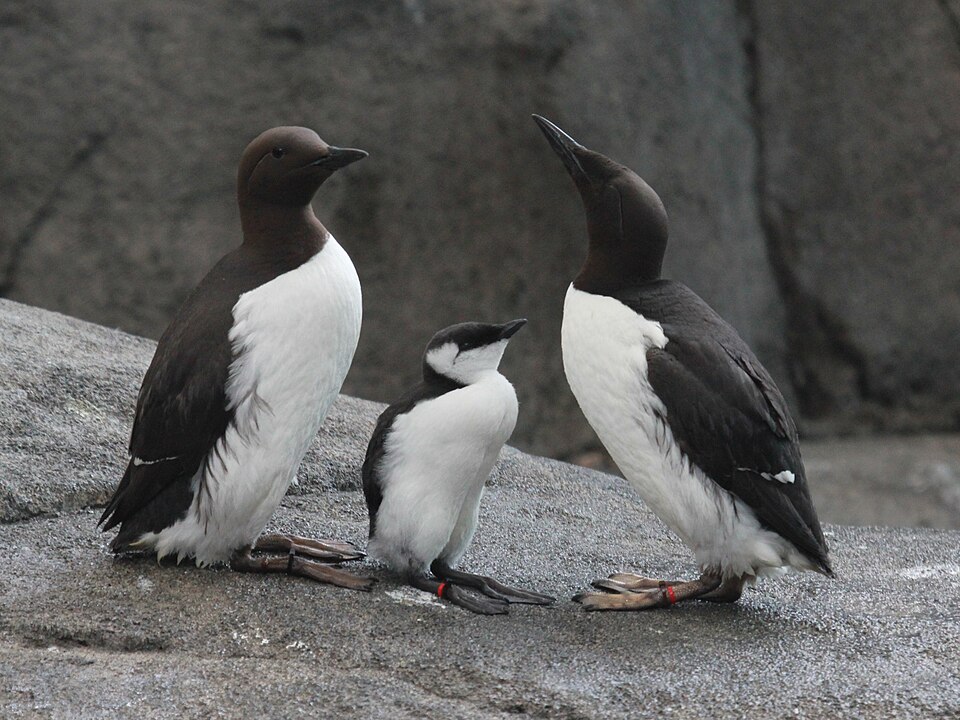
The Common Guillemot (Uria aalge) is a seabird of the auk family, often compared to a "penguin of the Northern Hemisphere" because of its striking black and white plumage. It nests in dense colonies on coastal cliffs, where thousands of individuals can gather side by side. An excellent diver, it uses its short wings to propel itself underwater while pursuing fish. This species spends most of the year at sea, returning to land only to breed. It is widely distributed throughout the temperate and subarctic regions of the North Atlantic and North Pacific.
Adults measure roughly 40 to 45 cm in length with a wingspan of 65 to 70 cm. The back and head are dark brown-black to black, contrasting with a pure white belly. The bill is thin, pointed, and black, without an obvious hook, adapted for catching small fish. A "bridled" form, with a white ring around the eye and a white line behind it, occurs in a minority of individuals.
Characteristics
Indicative values: they vary by subspecies, sex and region.
Habitat and distribution
The species frequents rocky coasts and steep cliffs for breeding, as well as coastal and offshore marine waters for the rest of the year. It avoids areas without direct access to fish-rich waters. Breeding colonies are often located on islands or headlands that are difficult for terrestrial predators to reach.
CURRENT RANGE
The Great Auk is found on the coasts of the North Atlantic, notably in the United Kingdom, Scandinavia, Iceland and Canada, as well as on certain coasts of the North Pacific. It does not frequent Mediterranean waters or Tunisian coasts. Its populations winter at sea, sometimes far from their breeding sites.
Behaviour
The Common Guillemot is a gregarious species that forms vast noisy colonies on rocky cliffs during the breeding season. Pairs and neighbors communicate through characteristic guttural calls. Outside the breeding season, the bird leads an essentially pelagic life, solitary or in small floating groups on the water. Its swimming is powerful but its flight is direct and poorly maneuverable, requiring rapid and continuous wing beats.
Reproduction
The female lays a single egg directly on the bare rock of cliff ledges with no nest. The egg has a characteristic conical shape that prevents it from rolling accidentally into the void. Incubation lasts about a month, shared alternately between both parents. The chick leaves the cliff before it can even fly, jumping into the water accompanied by the male, who continues raising it at sea.
Peculiarities
The conical shape of the egg is a remarkable adaptation to life on narrow ledges without a nest. The species is capable of diving to considerable depths thanks to a body structure similar to that of penguins, although it is not related to them. The chick jumps from the cliff into the sea before it can fly, a spectacular behaviour observed at dusk.
Threats and conservation
The main threats include oil spills, which seriously affect populations at sea, as well as overfishing of the small fish on which the species depends. Human disturbance of colonies and introduced predators on some islands present local pressures. Climate change is altering prey availability in some regions.
Numbers and trends vary across sources and regions. See the IUCN assessment for the latest reference data.
Gallery
1 documented photographs.
References
Profile updated 08 September 2026 · Reviewed by the TunisieVet editorial team.
Comments (0)
No comments yet.
CONSERVATION STATUS
Least concern (LC)
IUCN source, latest published assessment.
Species health
Documented diseases for this species.
See the 4 diseases of this species Find a veterinarianThis information is provided for educational purposes only and is not a substitute for a veterinary consultation. If you have any concerns about your animal's health, consult a veterinarian.
Similar animals
Other species documented in Animalpedia.

TunisieVet in your pocket 📱🐾 Access your veterinary services wherever you are. [ Download the app ]
Learn more