
Presentation
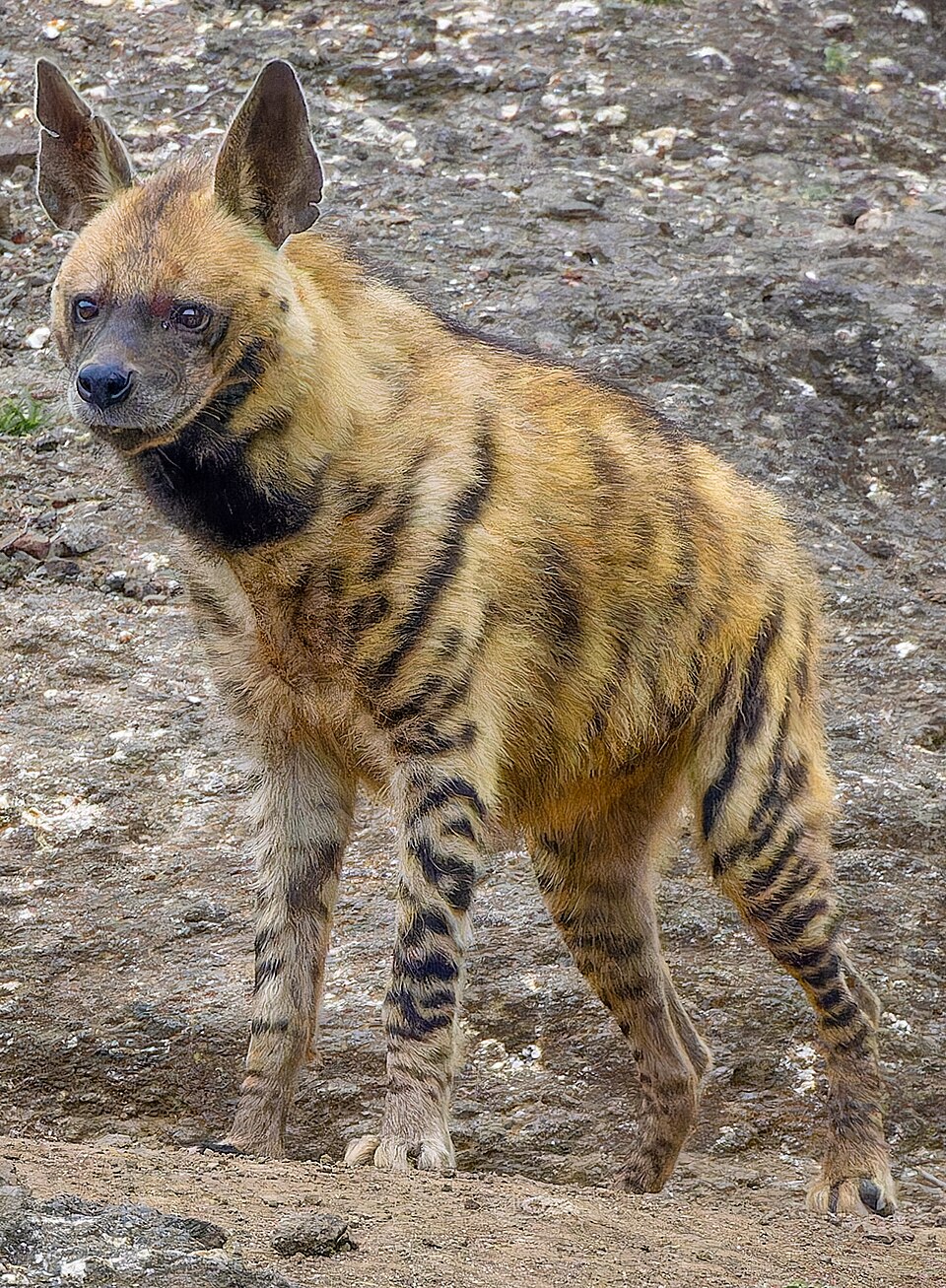
The Striped hyena is a medium-sized carnivore belonging to the Hyaenidae family. Recognizable by its gray-brown coat covered with well-marked black stripes, it has a robust and massive body with front legs longer than the hind legs, giving it a characteristic appearance slightly leaning forward.
Its massive skull houses extremely powerful jaws, with sturdy teeth adapted to crushing bones. The ears are pointed and medium sized, while its short, bushy tail is often erect. Its shaggy coat stands up easily when threatened, increasing its apparent volume.
Characteristics
Indicative values: they vary by subspecies, sex and region.
Habitat and distribution
Striped hyena frequents deserts, arid steppes and semi-desert mountainous regions. It adapts to dry and rocky environments, with a preference for areas with rock cracks, burrows or cavities where it can rest. It avoids dense forests and areas that are too humid.
CURRENT RANGE
The species is distributed in North Africa (Morocco, Algeria, Tunisia, Libya, Egypt) and in the Arabian Peninsula to western India. Its population is fragmented and localized, reflecting the availability of suitable arid habitats. It has disappeared from many areas where it was once present.
Behaviour
A mainly nocturnal and solitary animal, the Striped hyena is more discreet and shy than its congeners. It is generally mute, rarely emitting sounds, unlike other hyena species. It roams its territory in search of food, traveling several kilometers each night, and rests in burrows or rock fissures.
Reproduction
Striped hyena reaches sexual maturity around 3-4 years old. Mating takes place in autumn, and after a gestation of about 90 days, the female gives birth to 1-4 young, usually 2-3. The young remain in the den for several months before gradually exploring their environment. Breastfeeding lasts approximately 12-18 months.
Peculiarities
The Striped hyena has exceptionally strong teeth capable of crushing bones. Unlike its noisier cousins, it communicates more through scent marks and body postures. It plays an important ecological role as a cleaner, reducing the spread of disease by consuming carrion. Its tolerance of hostile environments makes it a carnivore remarkably adapted to deserts.
Threats and conservation
Although the conservation status is "Near Threatened", Striped hyena faces increasing pressure. Habitat loss and fragmentation due to urban and agricultural expansion are reducing its territories. She is sometimes persecuted by man who fears her or wrongly blames her for livestock losses. The decline in carrion populations also affects its food availability.
Numbers and trends vary across sources and regions. See the IUCN assessment for the latest reference data.
Gallery
1 documented photographs.
References
UICN — Liste rouge des espèces menacées
Profile updated 02 September 2026 · Reviewed by the TunisieVet editorial team.
Comments (0)
No comments yet.
CONSERVATION STATUS
Near threatened (NT)
IUCN source, latest published assessment.
Species health
Documented diseases for this species.
See the 4 diseases of this species Find a veterinarianThis information is provided for educational purposes only and is not a substitute for a veterinary consultation. If you have any concerns about your animal's health, consult a veterinarian.
Related species
To discover around: Striped hyena
Videos, facts, stories and records linked to this species.
Similar animals
Other species documented in Animalpedia.

TunisieVet in your pocket 📱🐾 Access your veterinary services wherever you are. [ Download the app ]
Learn more