
Presentation
The Guinea pig is a small domestic rodent native to South America, bred for millennia by Andean civilizations. Today, it is one of the most popular pets in the world, loved for its gentle temperament and characteristic vocalizations.
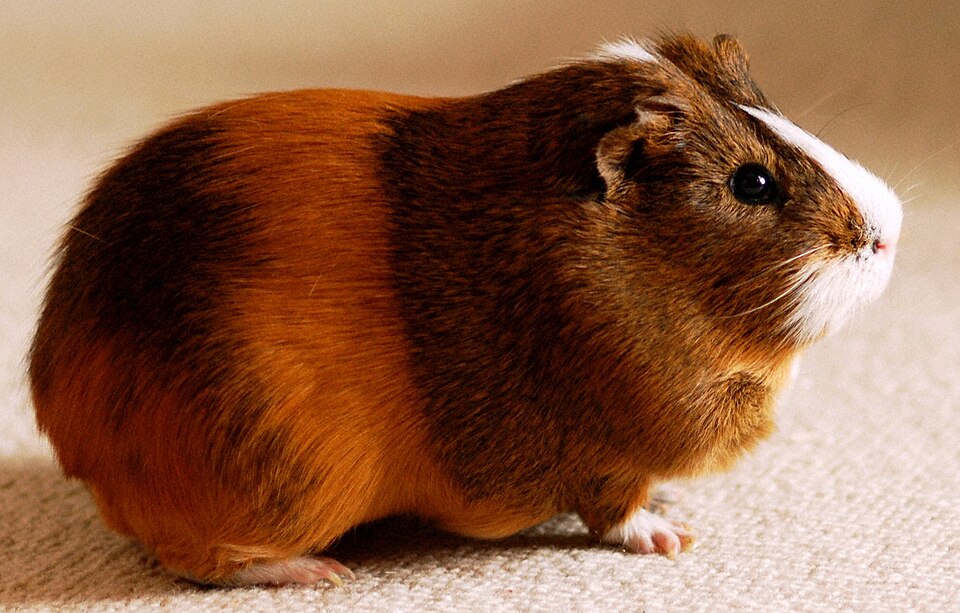
The Guinea pig has a stocky, rounded body with no visible tail. Its coat, short to medium, exists in multiple varieties of colors and textures depending on the breed. Its eyes are large and expressive, and its ears are small and rounded. Its legs are short and robust, perfectly adapted to walking.
Did you know?
Why do guinea pigs squeal?
Characteristics
Indicative values: they vary by subspecies, sex and region.
Habitat and distribution
Fully domesticated, the Guinea pig lives exclusively in urban environments, as a pet. In the wild, its ancestors populated the mountainous regions and grasslands of the South American Andes. In captivity, it requires a spacious, well-ventilated space with a stable temperature for its well-being.
CURRENT RANGE
Originally from the Andean regions of South America (Peru, Bolivia, Ecuador, Colombia), Guinea pig no longer exists in the wild. Its supposed ancestor, Cavia tschudii, still inhabits the Andes mountains. Today, the domestic Guinea pig can be found all over the world where it is kept as a pet.
Behaviour
A social and gregarious animal, the Guinea pig thrives best in the company of peers. It is active mainly in the late afternoon and early evening. Their varied vocalizations (squeaks, purrs, cackles) express their emotions and facilitate communication with their peers and caregivers.
Reproduction
Guinea pig reaches sexual maturity between 4 and 8 weeks. The gestation period is short, around 63 days, and females can have 2 to 3 litters per year. The young are born well developed and mobile, generally weaned after 3 weeks. Mating can be very early, hence the importance of separation of the sexes in young individuals.
Peculiarities
Remarkable peculiarity: the Guinea pig cannot synthesize vitamin C and must obtain it through its diet, at the risk of developing scurvy. It also has a very sensitive digestive system requiring a stable diet rich in fiber. His intelligence and docility make him an excellent educational companion for children.
Threats and conservation
The domestic Guinea pig does not present conservation threats, being dependent on humans for survival. However, in captivity it can suffer from diseases, parasites and inadequate breeding conditions. Abandonment or involuntary release does not pose a major ecological risk, because the species cannot persist sustainably in a temperate natural environment.
Numbers and trends vary across sources and regions. See the IUCN assessment for the latest reference data.
Gallery
1 documented photographs.
References
Profile updated 03 September 2026 · Reviewed by the TunisieVet editorial team.
Comments (0)
No comments yet.
CONSERVATION STATUS
Not evaluated (NE)
IUCN source, latest published assessment.
Species health
Documented diseases for this species.
This information is provided for educational purposes only and is not a substitute for a veterinary consultation. If you have any concerns about your animal's health, consult a veterinarian.
To discover around: Guinea pig
Videos, facts, stories and records linked to this species.
Similar animals
Other species documented in Animalpedia.

TunisieVet in your pocket 📱🐾 Access your veterinary services wherever you are. [ Download the app ]
Learn more