
Presentation
The Cat is a small domestic carnivore belonging to the Felidae family. Since its domestication around 10,000 years ago, it has become one of the most popular pets in the world. Sleek and agile, the Cat combines great adaptability to various environments with an independent and affectionate temperament.
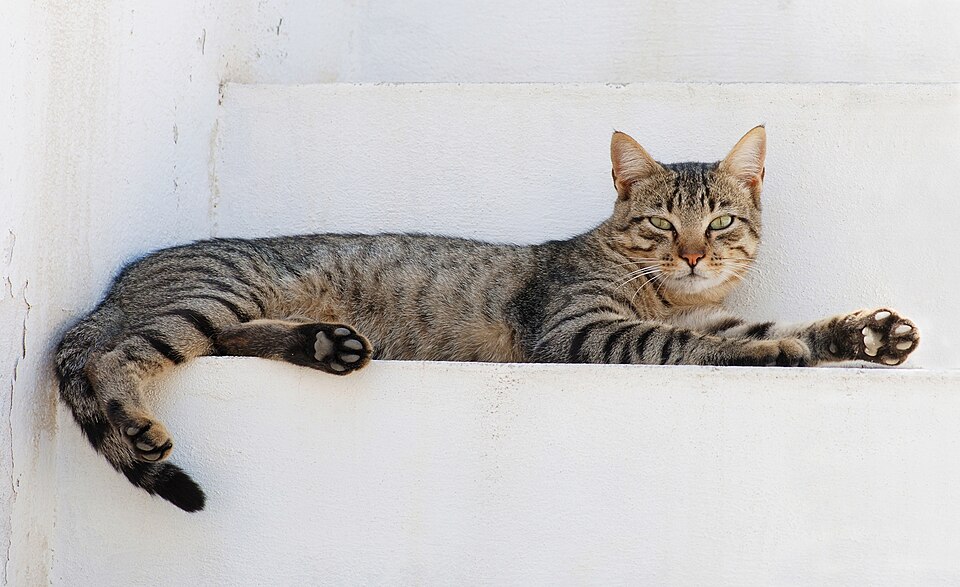
The Cat is distinguished by a supple and muscular body covered with a short or long coat depending on the breed. It has large and bright eyes, moving pointed ears, and retractable claws which allow it great precision in its movements. Its exceptional night vision, keen sense of smell and sensory whiskers make the Cat a highly adapted predator.
Did you know?
Why can free access to food promote overweight?
Characteristics
BREEDS
Indicative values: they vary by subspecies, sex and region.
Habitat and distribution
The Cat adapts to many environments: farms, meadows, urban areas and homes. Domesticated, it mainly lives alongside humans in homes. In its semi-wild state, it occupies open spaces where it can hunt and become territorial. Cat can survive in a variety of environments, from temperate to Mediterranean areas, as long as it has shelter and access to food.
CURRENT RANGE
Domestic Cat is found on all continents except Antarctica. Its distribution range covers global urban, rural and agricultural environments. Originally from the Near East, it gradually spread with human populations and today constitutes one of the most widely distributed species in the world.
Behaviour
The Cat is a territorial and nocturnal animal by nature, although it adapts to human rhythms. He is known for his independence, but he also forms affectionate bonds with his owners. The Cat communicates through meows, purrs and sophisticated body language. He spends a lot of time grooming and playing, activities that are essential to his physical and mental well-being.
Reproduction
The Cat reaches sexual maturity between 6 and 12 months. Females are polyestrous, with several breeding periods per year marked by characteristic vocal calls. Gestation lasts approximately 63 to 65 days, and the female generally gives birth to 3 to 5 Catons per litter. Catons become independent around 3 months of age, although weaning begins earlier.
Peculiarities
The Cat has a remarkable righting reflex ability: when it falls, it can pivot in the air to land on its legs. Its retractable claws remain permanently sharp. The Cat can also see in color, although differently from humans, and its hearing is exceptionally developed, allowing it to detect ultrasound. Its purring, the exact function of which remains partially mysterious, could be used for relaxation and communication.
Threats and conservation
The domestic Cat faces no serious threats as a species, its population being stable and widespread. However, unneutered individuals may be exposed to communicable diseases such as FIV or feline panleukopenia. The welfare of Cats is highly dependent on the responsibility of their owners and the treatment they receive.
Numbers and trends vary across sources and regions. See the IUCN assessment for the latest reference data.
Gallery
1 documented photographs.
References
Profile updated 09 August 2026 · Reviewed by the TunisieVet editorial team.
Comments (0)
No comments yet.
CONSERVATION STATUS
Not evaluated (NE)
IUCN source, latest published assessment.
Species health
Documented diseases for this species.
See the 76 diseases of this species Find a veterinarianThis information is provided for educational purposes only and is not a substitute for a veterinary consultation. If you have any concerns about your animal's health, consult a veterinarian.
Related species
On the TunisieVet marketplace
Food, hygiene and accessories for cat, sold by verified shops and delivered across Tunisia.
Buying advice, not medical advice: for a diagnosis or treatment, consult your veterinarian.
Did you know? — Cat
To discover around: Cat
Videos, facts, stories and records linked to this species.
Similar animals
Other species documented in Animalpedia.

TunisieVet in your pocket 📱🐾 Access your veterinary services wherever you are. [ Download the app ]
Learn more