Presentation
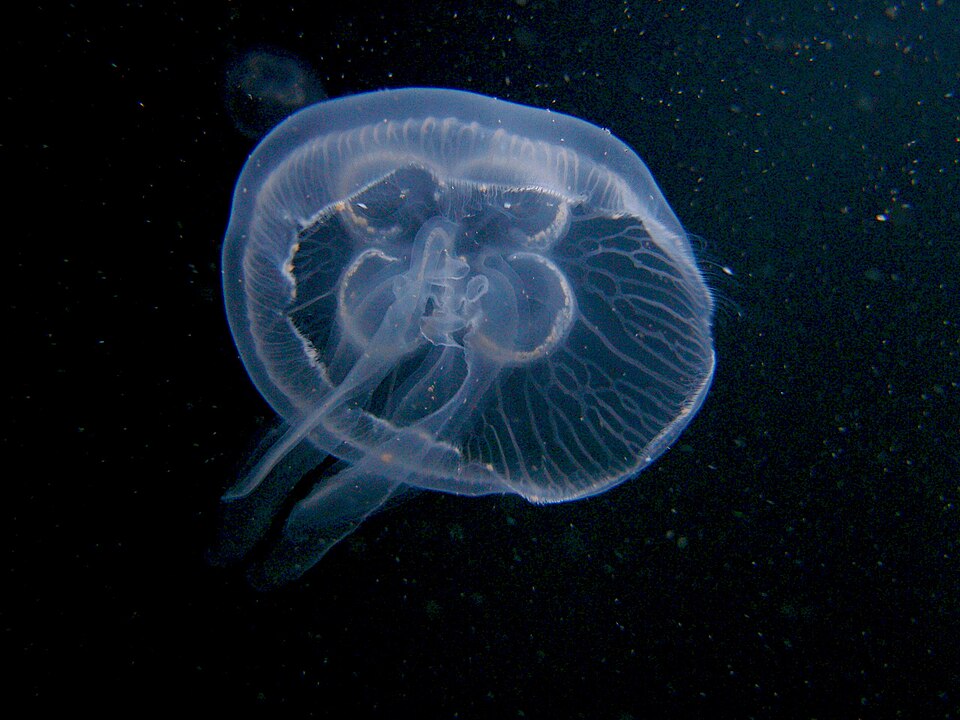
The jellyfish is a gelatinous marine animal belonging to the phylum Cnidaria, found in every ocean in the world for hundreds of millions of years. Its translucent, bell- or umbrella-shaped body is composed of more than 95 percent water, giving it great lightness in the water column. It moves through rhythmic pulsations of its bell but relies mainly on ocean currents for long-distance travel. Many species have stinging tentacles used to capture prey and defend themselves. The term "jellyfish" actually encompasses several thousand different species of varying sizes and shapes.
The jellyfish's body, called the bell, lacks a skeleton and is made up of a gelatinous substance called mesoglea. It has a diffuse nervous system without a centralized brain, as well as rudimentary sensory organs called rhopalia that detect light and gravity. Its tentacles are equipped with stinging cells, cnidocytes, which contain venom.
Characteristics
Indicative values: they vary by subspecies, sex and region.
Habitat and distribution
Jellyfish live exclusively in marine environments, from shallow coastal waters to the ocean's greatest depths. They inhabit both warm tropical waters and cold polar seas. Some species tolerate variations in salinity and are found in estuaries and coastal lagoons.
CURRENT RANGE
Jellyfish are present in every ocean and sea on Earth without exception. They occur in the Mediterranean, including off the Tunisian coast, as well as in Arctic waters and the tropical Pacific. Their distribution varies according to ocean currents, water temperature, and food availability.
Behaviour
The jellyfish is a solitary animal that lives with the ocean currents, sometimes forming large swarms called "blooms" when environmental conditions are favorable. It alternates between active swimming phases with pulsations and passive drifting. Its behavior is mainly driven by the search for food and avoidance of predators.
Reproduction
The jellyfish life cycle typically alternates between a sexual phase—the adult jellyfish—and an asexual fixed phase called the polyp. Adult jellyfish release their gametes into the water, where fertilization produces a larva that attaches to a surface and develops into a polyp. The polyp then reproduces by budding, releasing new young jellyfish into the water.
Peculiarities
Some jellyfish species are bioluminescent and produce light when disturbed. The jellyfish Turritopsis dohrnii is capable, under certain conditions, of reverting to a polyp stage after reaching adulthood. Jellyfish have no heart, blood, or brain.
Threats and conservation
Jellyfish populations are not globally threatened and are actually proliferating in some areas, a trend favored by climate warming and overfishing of their natural predators. Locally, pollution and destruction of coastal habitats can affect certain species. Jellyfish blooms cause problems mainly for human activities, such as fishing, tourism, and the operation of power plants.
Numbers and trends vary across sources and regions. See the IUCN assessment for the latest reference data.
Gallery
1 documented photographs.
References
Profile updated 31 August 2026 · Reviewed by the TunisieVet editorial team.
Comments (0)
No comments yet.
CONSERVATION STATUS
Least concern (LC)
IUCN source, latest published assessment.
Species health
Documented diseases for this species.
Find a veterinarianThis information is provided for educational purposes only and is not a substitute for a veterinary consultation. If you have any concerns about your animal's health, consult a veterinarian.
To discover around: Jellyfish
Videos, facts, stories and records linked to this species.
Similar animals
Other species documented in Animalpedia.

Be among the first to use our app. Sign up and get early Google Play access.
Discover