
Presentation
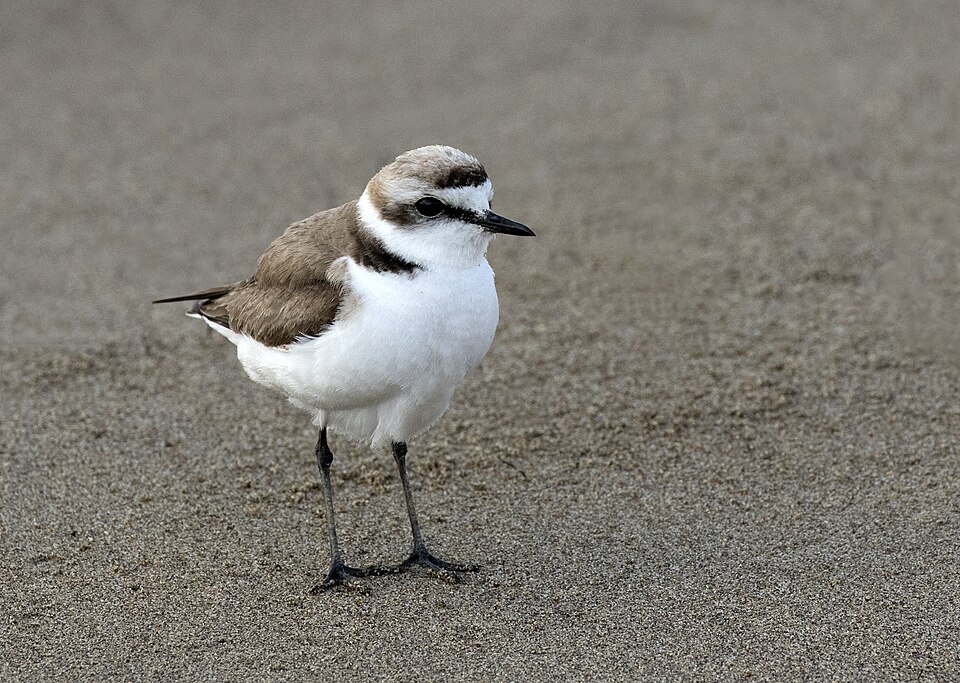
The plover is a small shorebird belonging to the family Charadriidae, recognizable by its short bill, rounded head, and stocky build. It frequents shorelines, mudflats, and wetland areas where it moves in short darts punctuated by abrupt stops. Several plover species exist worldwide, with some migratory populations covering long distances between breeding and wintering sites. In Tunisia, different plover species are observed, notably on coastal wetlands and salt marshes. Its plumage is often cryptic—brown, grey, or black and white depending on the species—allowing it to blend into its surroundings. It is a bird appreciated by birdwatchers for its characteristic feeding behavior.
The plover has a compact body, slender legs of medium length, and a short straight bill adapted for capturing small prey. Its head is round and its eyes are large, giving it good vision for spotting movement on the ground. Plumage varies by species but often displays contrasting patterns on the head and breast.
Characteristics
Indicative values: they vary by subspecies, sex and region.
Habitat and distribution
Plovers frequent open habitats near water: mudflats, beaches, lake shores, and coastal wetlands. Some species also occupy steppes or open ground far from the coast during breeding season. The availability of invertebrates and the absence of dense vegetation are important factors for their settlement.
CURRENT RANGE
Plovers are found on most continents, with great species diversity in Europe, Africa, Asia, and the Americas. Several migratory species travel between Eurasia and Africa for winter. In Tunisia, they are observed notably in coastal wetlands and sebkhas, particularly during migration periods and wintering.
Behaviour
The plover is a gregarious bird outside the breeding season, often forming groups on mudflats and beaches. It employs a typical hunting technique of running then abruptly freezing to scan the ground. Some species are highly migratory and cover great distances between breeding and wintering areas. It produces piping calls used for communication and alerting to predators.
Reproduction
Plovers typically nest on the ground itself, in a simple, sparsely lined depression, often on beaches, mudflats, or open areas. The female usually lays three to four eggs with effective camouflage against predators. Both parents take part in incubation and caring for the young, which are precocial and leave the nest quickly after hatching.
Peculiarities
The run-stop-capture hunting behaviour is a distinctive characteristic of the genus. Some species use the 'broken wing' display, simulating an injured wing to draw a predator away from the nest. Egg and chick camouflage is an effective adaptation to ground life.
Threats and conservation
Degradation and urbanization of coastal wetlands threaten plover nesting and feeding sites. Human disturbance on beaches during breeding season can reduce nesting success. Pollution and declining invertebrate populations also affect their food resources.
Numbers and trends vary across sources and regions. See the IUCN assessment for the latest reference data.
Gallery
1 documented photographs.
References
Profile updated 23 August 2026 · Reviewed by the TunisieVet editorial team.
Comments (0)
No comments yet.
CONSERVATION STATUS
Least concern (LC)
IUCN source, latest published assessment.
Species health
Documented diseases for this species.
Find a veterinarianThis information is provided for educational purposes only and is not a substitute for a veterinary consultation. If you have any concerns about your animal's health, consult a veterinarian.
Similar animals
Other species documented in Animalpedia.
