
Presentation
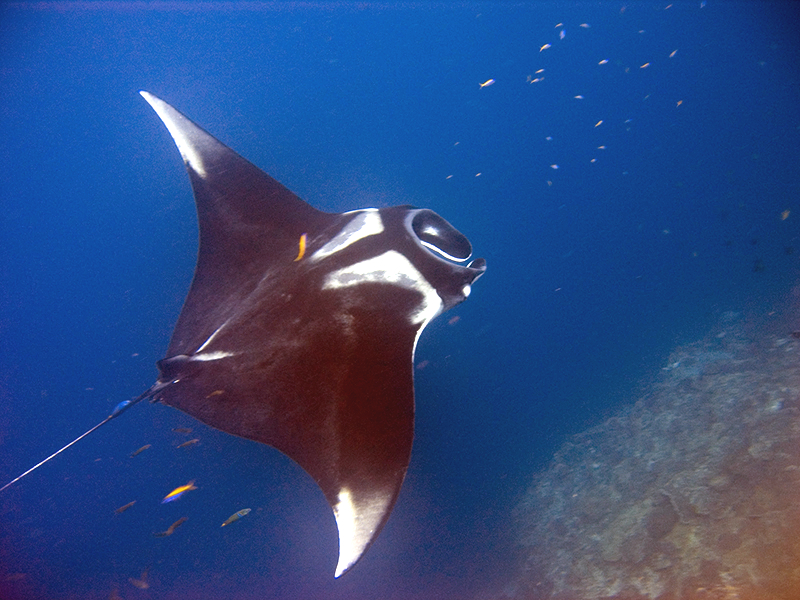
The giant Giant manta ray is the largest representative of the Mobulidae family, recognizable by its immense pectoral fins and its large terminal mouth used to filter plankton. It inhabits tropical and subtropical waters around the world, often near coral reefs, seamounts or in the open ocean. This species migrates long distances following seasonal food concentrations. Despite its impressive size, it is completely harmless to humans. Its slow reproduction and late maturity make it particularly vulnerable to fishing pressure. It is the subject of conservation programs in several countries due to its decline observed on a global scale.
This cartilaginous fish has a flattened diamond-shaped body, large wing-like pectoral fins, and horn-shaped cephalopalps near the mouth. Its dorsal coloration varies from black to dark gray with white markings unique to each individual, while the belly is generally white. It lacks a venomous caudal stinger, unlike other rays. Its flexible and light skeleton allows it to move gracefully despite its imposing size.
Characteristics
Indicative values: they vary by subspecies, sex and region.
Habitat and distribution
This species frequents coastal and pelagic waters of tropical and subtropical zones, often near coral reefs or seamounts. It can evolve on the surface or several tens of meters deep depending on the availability of food. It carries out significant seasonal migrations in the open sea. It is rarely observed in cold or temperate waters.
CURRENT RANGE
The species occurs in tropical and subtemperate waters of the Atlantic, Indian and Pacific Oceans. It is found particularly off the coast of East Africa, Indonesia, Mexico, Mozambique and Australia. It likes areas where currents converge, rich in plankton. Its presence in the Mediterranean remains anecdotal and not regularly confirmed.
Behaviour
The giant Giant manta ray is a pelagic animal, often solitary but observed in small groups on feeding or breeding sites. She practices filter-feeding by swimming slowly through concentrations of plankton, sometimes making vertical loops. She regularly visits “cleaning stations” where cleaning fish rid her skin of parasites. Its behavior is non-aggressive towards humans and it sometimes tolerates the approach of divers.
Reproduction
Reproduction is ovoviviparous, with a gestation estimated between 12 and 13 months. The female generally gives birth to a single young, rarely two, already capable of swimming and feeding on its own. The interval between two births can extend over several years, limiting the rate of population renewal. Sexual maturity is reached late, around the age of 8 to 10 years.
Peculiarities
Each individual has a unique ventral pattern of black spots, allowing individual photographic identification by researchers. It has the largest relative brain among all fish, suggesting high cognitive abilities. It is capable of jumping out of the water, although this behavior remains rare. It maintains regular symbiotic relationships with cleaner fish.
Threats and conservation
The giant Giant manta ray is threatened by targeted and accidental fishing, particularly for its gills used in traditional Asian medicine. Collisions with boats and entanglement in fishing gear also constitute major risks. The degradation of coastal habitats and plastic pollution also affect its feeding areas. Its low fecundity makes the recovery of populations very slow after a decline.
Numbers and trends vary across sources and regions. See the IUCN assessment for the latest reference data.
Gallery
1 documented photographs.
References
Profile updated 19 August 2026 · Reviewed by the TunisieVet editorial team.
Comments (0)
No comments yet.
CONSERVATION STATUS
Endangered (EN)
IUCN source, latest published assessment.
Species health
Documented diseases for this species.
This information is provided for educational purposes only and is not a substitute for a veterinary consultation. If you have any concerns about your animal's health, consult a veterinarian.
To discover around: Giant manta ray
Videos, facts, stories and records linked to this species.
RECORD
up to 7 m wingspan
The largest ray in the world
Maximum span measured between the tips of the pectoral fins in the largest individuals rec...
Similar animals
Other species documented in Animalpedia.

TunisieVet in your pocket 📱🐾 Access your veterinary services wherever you are. [ Download the app ]
Learn more