
Presentation
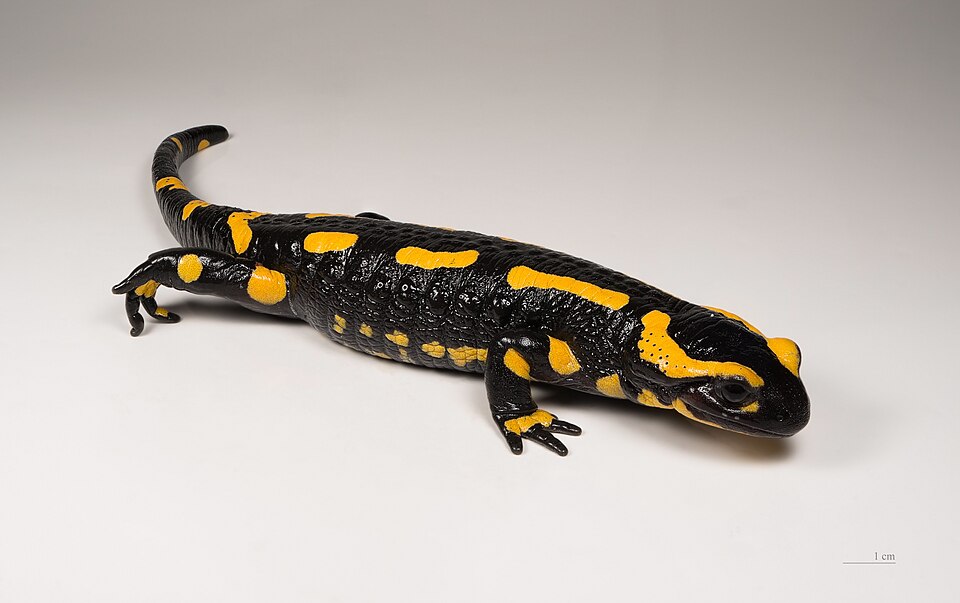
Salamander is an urodele amphibian characterized by an elongated body, four short legs and a long tail persisting into adulthood. The spotted Salamander (Salamandra salamandra) is the best-known species in Europe, recognizable by its black coat marked with bright yellow spots. It leads a discreet life, mainly nocturnal and terrestrial, near humid and wooded environments. Its glandular skin secretes toxic substances which protect it from many predators. Unlike frogs, it moves by walking rather than jumping. Several species of Salamanders are raised as NAC in terrariums.
The body is elongated, the skin smooth and moist, often slippery to the touch. The black and yellow coloring of the spotted Salamander serves as a warning (aposematism) to predators. The tail, long and muscular, can represent almost half of the total body length. The parotoid glands located behind the head secrete a toxin called samandarin.
Characteristics
Indicative values: they vary by subspecies, sex and region.
Habitat and distribution
The Salamander prefers humid, deciduous or mixed forests, rich in stagnant or slow-moving water points for the reproduction of larvae. It needs a cool, shaded environment rich in shelter such as stones, stumps or thick litter. Wetlands and slow-flowing rivers provide essential egg-laying sites. It avoids environments that are too dry or too exposed to the sun.
CURRENT RANGE
The spotted Salamander occurs in central and southern Europe, as well as northwest Africa. Other species of Salamanders are found in North America and Asia. The family Salamandridae is generally absent from South America, Oceania and sub-Saharan Africa. In Tunisia, the species is present in the humid forests of the north of the country.
Behaviour
The Salamander is a solitary and mainly nocturnal animal, which hides during the day under stones, dead trunks or in damp forest litter. It becomes lethargic during cold or very dry periods to limit dehydration. Not very fierce but slow, it relies on its skin toxicity rather than flight to defend itself. She can regenerate certain parts of her body, such as the tail or a lost limb.
Reproduction
Fertilization is internal but without direct mating: the male deposits a spermatophore which the female recovers with her cloaca. In the spotted Salamander, the female is ovoviviparous and gives birth directly into the water of small aquatic larvae equipped with external gills. Metamorphosis to the adult terrestrial form occurs after several months. Sexual maturity is reached around 3 to 5 years old depending on the species.
Peculiarities
The Salamander skin toxin, samandarin, may cause irritation in humans upon contact with mucous membranes. The species is sometimes associated in ancient legends with resistance to fire, a belief without scientific basis. Its capacity for tissue regeneration makes it an important study model in biology.
Threats and conservation
The destruction and fragmentation of forest and wetland habitats threaten local populations. Water pollution, particularly by pesticides, affects the survival of aquatic larvae. A pathogenic fungus (Batrachochytrium salamandrivorans) causes significant mortality in certain European populations. Traffic for the NAC trade constitutes additional pressure on certain species.
Numbers and trends vary across sources and regions. See the IUCN assessment for the latest reference data.
Gallery
1 documented photographs.
References
Profile updated 31 August 2026 · Reviewed by the TunisieVet editorial team.
Comments (0)
No comments yet.
CONSERVATION STATUS
Least concern (LC)
IUCN source, latest published assessment.
Species health
Documented diseases for this species.
This information is provided for educational purposes only and is not a substitute for a veterinary consultation. If you have any concerns about your animal's health, consult a veterinarian.
To discover around: Salamander
Videos, facts, stories and records linked to this species.
Similar animals
Other species documented in Animalpedia.

TunisieVet in your pocket 📱🐾 Access your veterinary services wherever you are. [ Download the app ]
Learn more