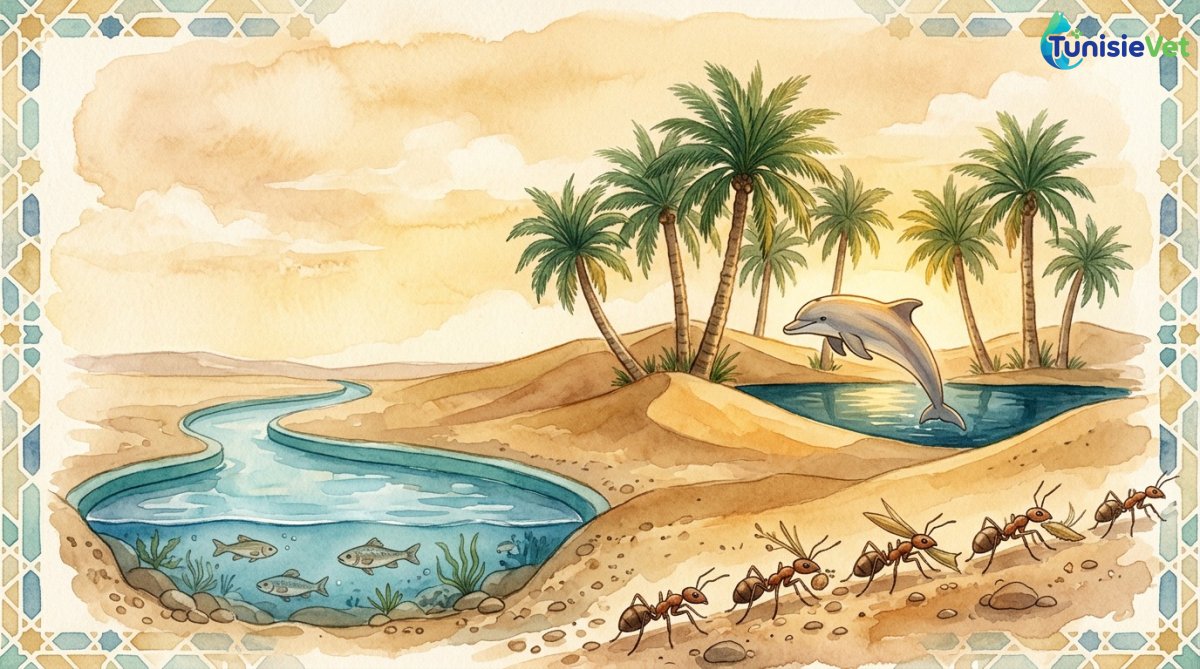
From the tiniest insect in the sand to the most majestic whales of the deep seas, each living creature bears witness, in its own way, to an intended order and infinite wisdom in creation.
On land and in the seas, a multitude of living beings populate creation: from ants that build their underground cities to fish that traverse the oceans in countless schools, each creature holds a precise place in a balance that the Qur'an continually brings to the attention of those who reflect.
A Populated and Ordered Creation
The Qur'an speaks repeatedly of the diversity of life, whether it be beasts that walk on four legs, those that crawl upon the ground, or birds that fly upon their wings. In Surah Al-An'am, Allah reminds us that no creature is left to chance:
﴿ وَمَا مِن دَابَّةٍ فِي الْأَرْضِ وَلَا طَائِرٍ يَطِيرُ بِجَنَاحَيْهِ إِلَّا أُمَمٌ أَمْثَالُكُم ۚ مَّا فَرَّطْنَا فِي الْكِتَابِ مِن شَيْءٍ ۚ ثُمَّ إِلَىٰ رَبِّهِمْ يُحْشَرُونَ ﴾
"There is not an animal on earth, nor a bird that flies on its wings, but they are communities like you. We have not neglected anything in the Book. Then unto their Lord they will be gathered." (Surah Al-An'am, verse 38)
This verse recalls a truth often forgotten: animals, whether terrestrial or marine, form organized communities comparable in this way to human societies. Scholars have emphasized that this teaching invites us to regard the animal world with respect, and not merely as a resource without value of its own.
The Sea and Its Wonders
The Qur'an does not limit its view to dry land alone. Surah An-Nahl also speaks of the sea as a place of blessings, from which fresh meat is obtained for food and ornaments for adornment, while ships cleave through its waters. According to some scholars, this mention of marine creatures alongside land animals illustrates the breadth of divine mercy that extends over all habitats, from the arid desert to the unfathomable depths.
It is likewise recorded in an authenticated hadith narrated in Sahih al-Bukhari and Sahih Muslim the story of a man who, seeing a thirsty dog near a well, descended and filled his shoe with water to quench its thirst. The Prophet ﷺ taught that this man was forgiven by Allah for this act of compassion toward an animal. This narrative, though centered on a land animal, conveys a lesson valid for every creature, whether it lives on earth or in water: kindness toward living beings is never a negligible act in the sight of Allah.
Signs for Those Who Reflect
Muslim scholars have often meditated upon this diversity of species as an invitation to reflection. How can we explain that creatures as different as ocean whales and desert insects each obey precise laws of reproduction, nourishment, and migration, except by the will of a single Creator? This questioning runs through several surahs, where animals are cited as signs (ayat) meant to strengthen the faith of those who observe the world with attention.
From this contemplation arises a precious teaching for our daily lives: caring for animals, whether they live in our homes, our fields, or populate the seas, is to acknowledge the place that belongs to them in the work of the Creator. Feeding a hungry animal, relieving a wounded beast, protecting the natural balances that allow each species to live with dignity, are all gestures that fall within this tradition of mercy toward every living creature.