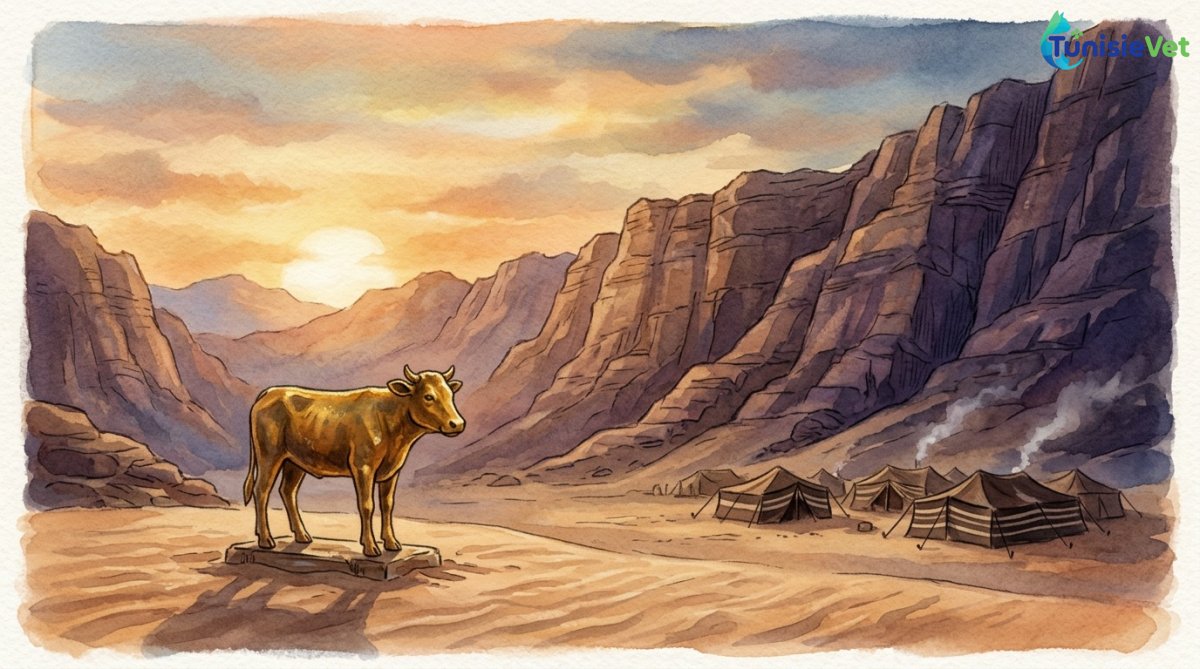
While the Prophet Moses ascended Mount Sinai to receive divine revelation, his people, left without visible guidance, turned toward an idol fashioned in the form of a calf. This Quranic account reveals the trials of faith and patience.
While the Prophet Moses (Moussa, peace be upon him) was absent for forty nights on Mount Sinai to receive the Tablets of the Law, the Children of Israel, left without apparent guidance, fell into error. Among them, a man named Samiri fashioned a calf from melted golden ornaments, and the calf began to emit a sound like a bellowing. The people, impressed, turned away from the worship of the One God to venerate this animal statue.
The Account in the Quran
This account is narrated in several surahs, notably in Surah Ta-Ha and Surah Al-A'raf. The Quran relates that Samiri had taken a handful of earth left by the footprint of the heavenly messenger and cast it into the molten metal, thus giving form to the calf. The text emphasizes the people's lack of discernment:
﴿ أَفَلَا يَرَوْنَ أَلَّا يَرْجِعُ إِلَيْهِمْ قَوْلًا وَلَا يَمْلِكُ لَهُمْ ضَرًّا وَلَا نَفْعًا ﴾
Do they not see that it does not return to them any speech and does not possess for them [the power to cause] harm or benefit?
(Surah Ta-Ha, verse 89)
This verse sheds light on the absurdity of such worship: a golden calf, however impressive by its bellowing, remained an inert creation, unable to speak truly, to harm or to aid anyone. The very choice of this animal as an object of worship was not insignificant: in the surrounding traditions of that time, the calf or bull sometimes symbolized strength and fertility, and certain neighboring peoples paid it cult. The Children of Israel, recently freed from slavery in Egypt, were tempted to reproduce these practices they had encountered.
Moses' Return and His Anger
When Moses came down from the mountain and discovered his people prostrated before this idol, he was seized with great distress. The Quran recounts his anger toward his brother Aaron (Haroun, peace be upon him), left in charge of the people, as well as his questioning of Samiri himself. The latter acknowledged having fashioned the calf according to what his soul had prompted him. Moses ordered that the idol be destroyed, burned and then scattered into the sea, so that no trace of this deviation would remain.
This passage is also mentioned in Surah Al-Baqarah, where it is recalled as an example of the trial endured by the Children of Israel after their liberation. Scholars of tafsir emphasize that this episode illustrates the fragility of faith when it is not constantly nourished, and how readily a people can be seduced by material symbols at the expense of the spiritual truth that had been taught to them.
A Lesson on the Respect Due to Creatures
It is noteworthy that it is not the animal itself that is condemned in this account, but the perversion of its image for purposes of idolatry. The calf, a creature of God among many others, bore no responsibility in this human deviation; it was the use that people made of it that was criticized and reproved. This distinction reminds us that, in the Islamic tradition, each animal holds a dignified place in creation, and it is the duty of believers never to substitute the respect owed to God with excessive or misplaced veneration toward a material form, whether animal or fashioned from precious metal.
This account, far from being merely an ancient story, invites each person to reflect on their own relationship with the world around them, including animals. These creatures, far from being mere objects or symbols at our disposal, deserve consideration and gentleness as beings in their own right. The TunisieVet site reminds us, through these narratives drawn from the Islamic tradition, how much kindness toward animals is integral to a balanced faith and a peaceful heart.