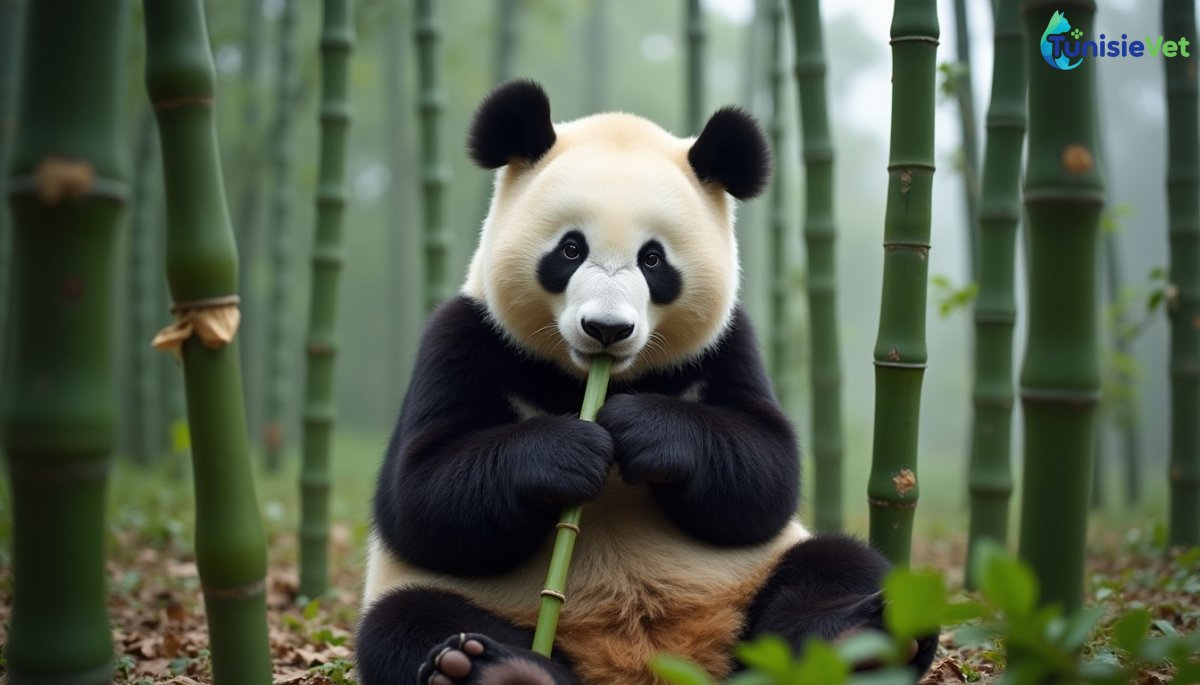
Zhuang Zhuang, the peaceful giant of the bamboo groves
Portrait of an iconic panda whose life illustrates the challenges of modern conservation.
Rédaction TunisieVet
3 min read · Published 1 month ago · 131 views
In the cool mists of the Sichuan mountains, where bamboos form green walls as far as the eye can see, lives an animal that has become a symbol in spite of itself: the giant panda. Among the individuals closely monitored by Chinese conservation programs, Zhuang Zhuang occupies a special place. Its name, which evokes quiet strength, sums up quite well the personality of this massive and good-natured animal, whose very existence tells the story of a species narrowly saved from extinction.
A life punctuated by bamboo
Like all giant pandas, Zhuang Zhuang spends most of his days eating. Bamboo, although poor in nutrients, constitutes almost 99% of its diet. To compensate for this low energy value, the animal must ingest considerable quantities of stems and shoots every day, sometimes more than ten kilos. This biological constraint shapes its entire lifestyle: little superfluous activity, long digestive naps, and travel limited to what is strictly necessary. The keepers who take care of him in conservation centers observe an animal that is solitary by nature, as are all pandas in the wild, but capable of showing an astonishing curiosity when faced with the new enrichments placed in its enclosure: trunks to climb, fresh hanging bamboo, pools of fresh water in summer.
Publicité
Publicité
This apparent nonchalance actually hides an animal perfectly adapted to its mountain environment, capable of climbing trees with surprising agility for its build, and endowed with a keen sense of smell which allows it to spot the best bamboo shoots from a distance.
An ambassador in spite of himself
The fate of Zhuang Zhuang, like that of many pandas born in captivity or collected in reserves, is closely linked to the breeding programs which have made it possible to increase the numbers of the species in recent decades. Long classified as an endangered species, the giant panda is now considered vulnerable, a notable progress achieved thanks to the protection of bamboo forests, the creation of ecological corridors between fragmented mountain ranges, and rigorous assisted reproduction programs.
In Tunisia, no panda lives naturally, but Zhuang Zhuang's story particularly resonates with Tunisian veterinarians and biologists who closely follow major global conservation successes. She reminds us that an endangered species can be saved when scientific research, political will and protection of natural habitats converge. This parallel feeds local reflections on the preservation of Tunisian species that are themselves weakened, such as the Cuvier's gazelle or certain coastal marine turtles, for which the same principles of habitat protection and rigorous monitoring apply.
Sometimes it only takes one animal to embody the entire struggle of a species.
Zhuang Zhuang continues to live peacefully, indifferent to his notoriety, busy as he is with his bamboos and his naps. But its existence, carefully documented and studied, is part of a global conservation effort whose lessons go far beyond the borders of China, to the point of inspiring animal protection programs well beyond its natural habitat.