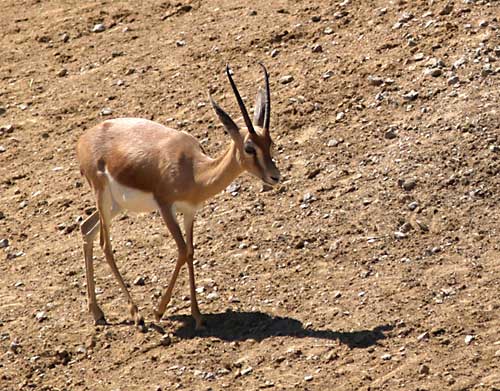
How does the Dorcas gazelle survive without drinking in the Sahara?
20 views · 1 week ago
The Dorcas gazelle practically never drinks: it gets all the water it needs from the desert plants it grazes on and from morning dew, while limiting its water losses thanks to very efficient kidneys, almost dry droppings and concentrated activity during cool hours.
A water-saving metabolism
The plants consumed by the Dorcas gazelle — acacias, grasses and succulent plants from the Sahara and southern Tunisia — often contain 30 to 60% water depending on the season and nighttime humidity. By grazing early in the morning, the animal also benefits from the dew condensed on the leaves, a seemingly negligible water resource but crucial in an environment where it sometimes does not rain for months. Its kidneys, which are very concentrating, produce highly concentrated urine which minimizes free water loss, and its intestines reabsorb most of the fecal moisture, giving dry, hard droppings characteristic of desert ungulates.
Another key strategy: tolerance to daytime hyperthermia. The Dorcas gazelle allows its body temperature to rise several degrees during the hottest hours rather than expending water sweating or panting to cool down; the accumulated heat is then passively dissipated at night, when the desert air cools significantly. It also reduces its motor activity during hot hours, resting in the rare shade of shrubs, and moves and feeds preferentially at dawn and dusk.
A species threatened even in southern Tunisia
These extreme adaptations do not prevent the Dorcas gazelle from being classified as vulnerable by the IUCN: poaching, disturbance by all-terrain vehicles and competition with livestock for rare pastures weaken the remaining populations, including in the arid zones of southern Tunisia where the species is still present but closely monitored by the authorities in charge of wildlife.