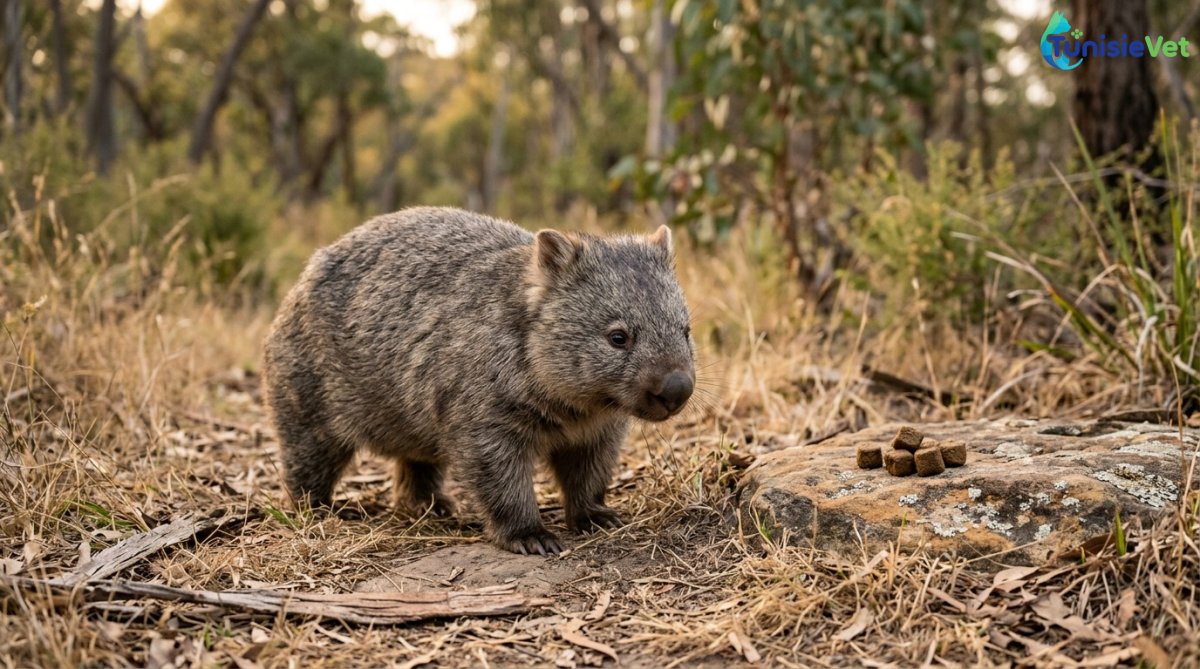
Its anus is round, yet the wombat leaves droppings that are almost perfect cubes. Where is that shape created, and what makes it?
Publicité
Publicité
The answer lies higher up the body. In the last 17% of the colon, the intestinal wall alternates two stiffer zones with two softer ones around its circumference. The stiff zones are roughly twice as thick and four times as rigid. The cubes are therefore shaped inside the body, before they leave it.
Researchers reproduced this pattern in a simplified two-dimensional mathematical model: the stiff zones contract faster, corners appear, and the shape becomes squarer as the contrast grows. This remains a hypothesis, not a full reproduction of the intestine. Drying, which is slow in this animal, also seems to play a part, according to work that is still debated.
The key study rests on just two or three bare-nosed wombats, all found dead after road collisions. The cubes measure about 2 cm along each side.