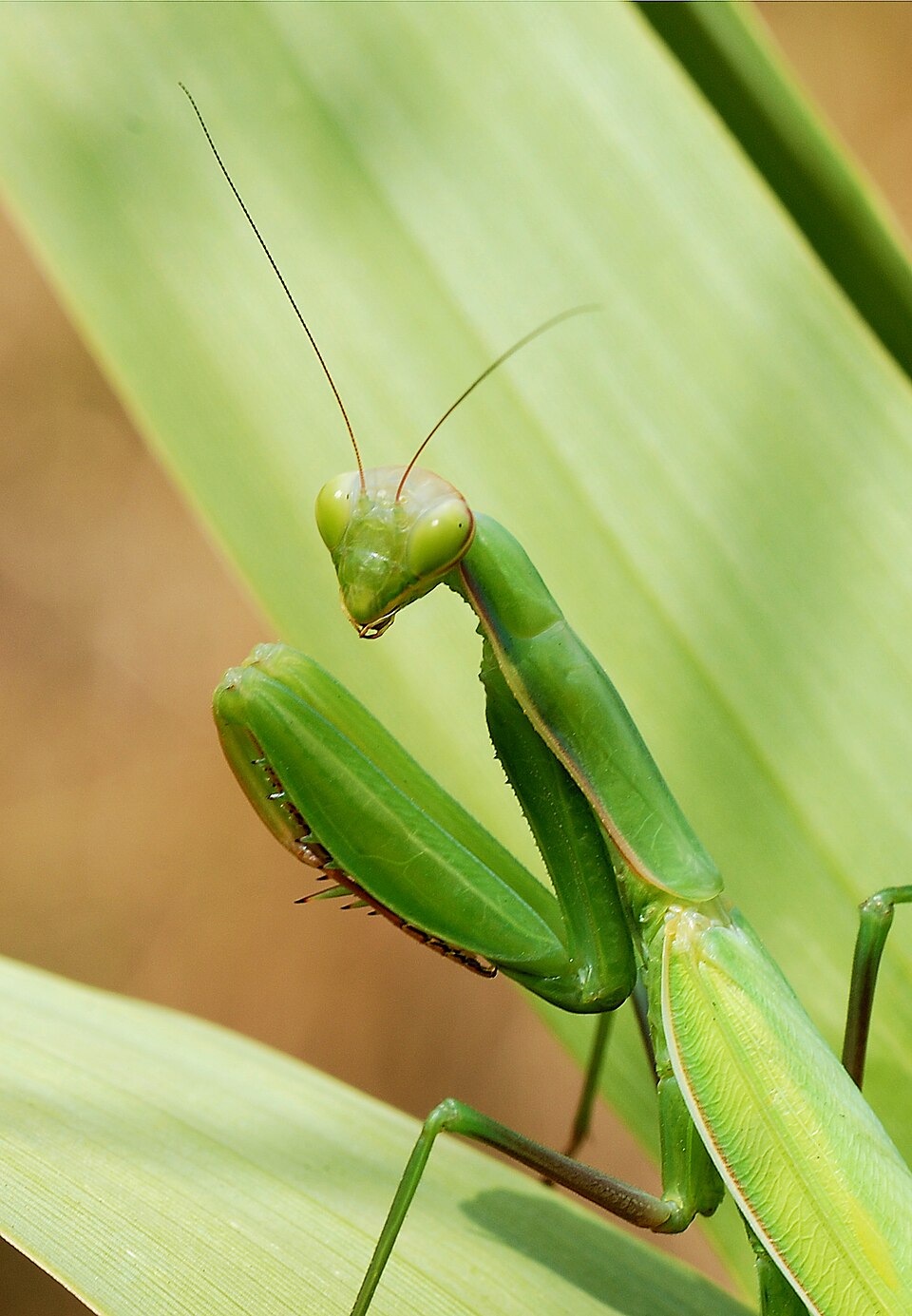
The praying mantis hunts by lying in wait: motionless, hidden by its green or brown camouflage, it waits for prey to come within range, then closes its spiny captor legs in just a few tens of milliseconds, a time too short for the captured insect to react.
Publicité
Publicité
An ambush regulated by vision and biomechanics
Mantis religiosa has a triangular head that moves 180° and two large compound eyes positioned frontally, which gives it binocular vision rare among insects. This arrangement allows it to estimate distance and depth before initiating the attack, much like a vertebrate predator would assess its target. It hardly moves until the prey is judged to be within exact reach of the front legs.
Capture is based on a catapult mechanism: energy is accumulated then released suddenly in the femur-tibia joints, propelling the spiny tibiae which close on the prey like pincers. The speed of movement, of the order of a few hundredths of a second, leaves little chance of escape for insects that are themselves fast, such as flies or locusts. The cryptic camouflage, associated with this prolonged immobility, also reduces the risk of the mantis itself being spotted by its own predators, particularly birds and lizards.
Sexual cannibalism, a reality to be qualified
The behavior where the female devours the male during or after mating is well documented in this species, but it is far from systematic: observations in the natural environment show a variable frequency depending on the context, in particular the hunger of the female and her ability to perceive the male before approaching. In many cases, mating takes place without any predation taking place, which calls for nuance to the often caricatured image of this behavior.