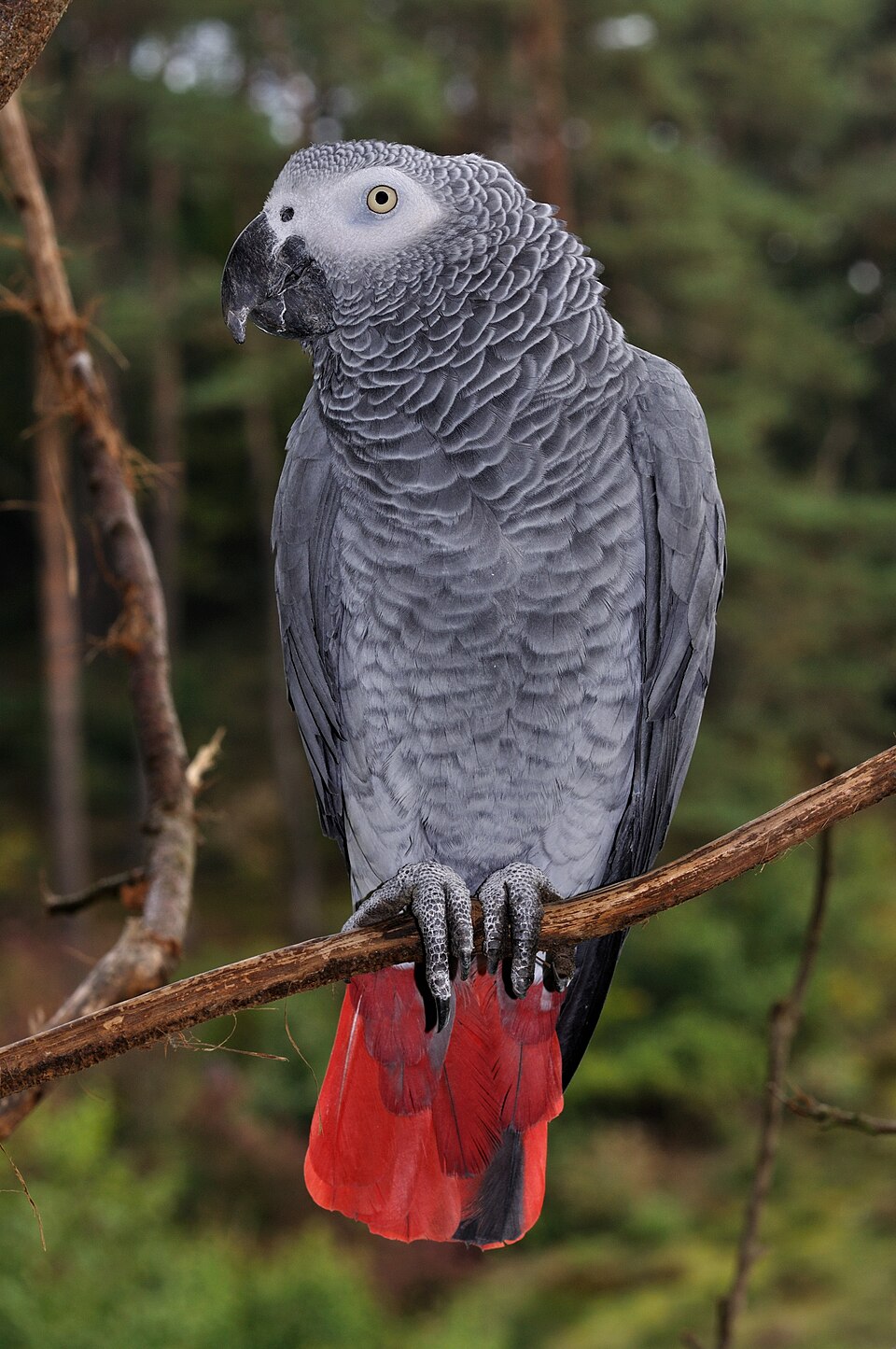
The Gabonese gray parrot imitates the human voice because it transposes an innate social behavior: learning the vocal “dialect” of its group. In nature, this group is a band of congeners; in captivity, for lack of other parrots, it is the human home that becomes its social and vocal reference.
Social learning, not a simple reflex
In Psittacidae, sound is not produced by the vocal cords but by the syrinx, an organ located at the bifurcation of the trachea towards the bronchi. Its structure allows fine modulation of frequency and timbre, which allows a variety of sounds far greater than that of a classic larynx and makes it possible to imitate human voices, including their intonation.
This capacity is part of a marked social biology: in the wild, the Gabonese gray lives in groups that can number several dozen individuals, with local vocal repertoires which serve for cohesion and mutual recognition. An individual isolated from its peers, as is the case in captivity, transfers this search for vocal contact to the humans around it, adopting their words as it would adopt the cries of its original group.
Beyond imitation: understanding usage
The work carried out by Irene Pepperberg on the parrot Alex has shown that this species does not just reproduce sounds mechanically. Alex used words in context to refer to objects, colors, materials or quantities, and was able to distinguish abstract categories such as “same” and “different”. He also had a beginning understanding of numbers, up to about six, associating the word with the actual quantity of objects presented. These results, published over several decades, have led part of the scientific community to consider that the Gabonese gray parrot goes beyond pure imitation to reach a form of referential communication, although the exact extent of this understanding remains debated among researchers.