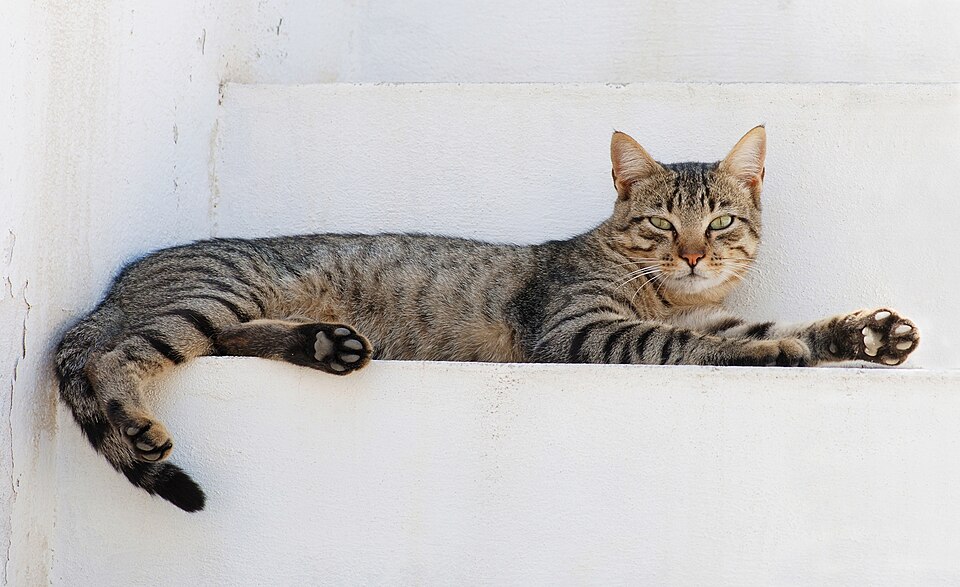
Cats often land on their feet thanks to the righting reflex, a reflex mechanism triggered by the inner ear which allows the body to rotate in free fall to reorient the front then the rear, without the need for support. However, this is not an absolute guarantee, especially in the event of a fall from a low height.
A reflex orchestrated by the inner ear
The vestibular system, housed in the inner ear, instantly detects the loss of vertical reference from the start of the fall. This information is transmitted to the brain which triggers an automatic motor sequence: the head pivots first to realign itself with the horizon, then driving the front gear, then the rear gear according to a characteristic time shift of two times.
This division into two successive rotations makes it possible to circumvent the law of conservation of angular momentum: by folding the front legs while spreading the rear legs (then the reverse), the cat modifies its inertia segment by segment without needing an external point of support. The tail plays a complementary balancing role, although cats with tail amputations retain this reflex. Once the body is realigned, the animal spreads its legs and arches its back to maximize the aerodynamic braking surface before impact.
Paratrooper cat syndrome: a real emergency
Contrary to popular belief, this reflex does not systematically protect the animal. “Parachutist cat syndrome”, well documented by feline veterinary clinics, refers to trauma following a fall from a balcony or a high window, particularly during short-distance falls: the cat then does not have the physical time to complete its rotation before impact. Limb fractures, thoracic trauma and maxillofacial injuries are among the most common injuries observed in feline medicine. Any fall, even seemingly benign, warrants rapid veterinary consultation. Securing balconies and windows (nets, grills) remains the most effective prevention measure for upper-floor accommodation.