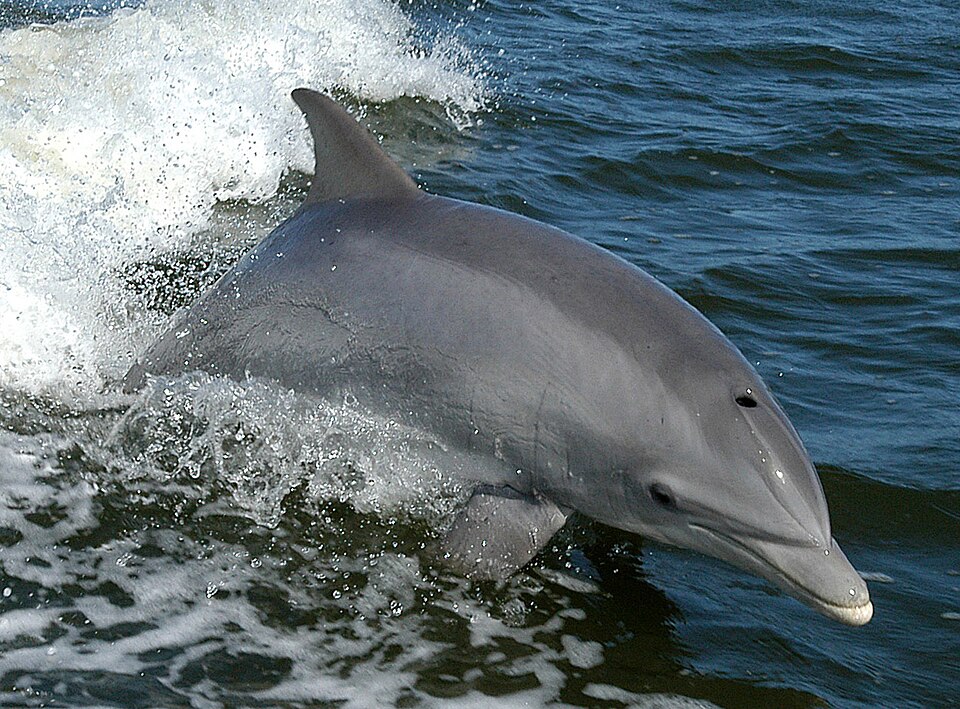
Yes, but never completely: the bottlenose dolphin practices unihemispheric sleep, where only one cerebral hemisphere rests at a time while the other remains vigilant, the opposite eye open, to continue swimming and above all to breathe voluntarily.
Why only one half of the brain sleeps at a time
Unlike most mammals, breathing is not automatic in cetaceans: each inspiration at the surface is a conscious act. A completely asleep bottlenose dolphin would stop coming up for air and drown. Evolution has therefore selected a “half” sleep: the left hemisphere sinks into slow-wave sleep while the right maintains wakefulness, then the roles are reversed after a few tens of minutes to a few hours, depending on the individual and the context.
During these phases, the animal reduces its activity, swims slowly in a circle or remains motionless near the surface, one eye closed (the one connected to the sleeping hemisphere) and the other open to watch for predators, conspecifics and obstacles. This mechanism also allows him to continue to breathe every few tens of seconds without ever losing the necessary motor control.
Publicité
Publicité
Electroencephalographic recordings made on captive dolphins have confirmed this alternation: the slow waves characteristic of sleep appear successively in one hemisphere then in the other, never simultaneously in both, which clearly distinguishes cetaceans from the classic bihemispheric sleep of terrestrial mammals.
An adaptation shared by Mediterranean populations
The bottlenose dolphins present off the Tunisian coast, particularly in the Gulf of Gabès and the Sicily Channel, depend on the same mechanism to survive in the open sea, far from any shelter where they can rest without risk. This vigilant sleep allows them to remain in continuous movement, an essential condition in an environment where prolonged immobility would expose them to both drowning and predators such as large sharks.