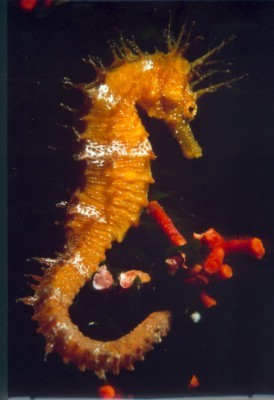
In the speckled seahorse, it is the male who carries the pregnancy: the female deposits her eggs in her ventral brood pouch using an ovipositor, he fertilizes them on site, then incubates them, oxygenates them and regulates their salinity for approximately three to four weeks before expelling dozens to several hundred autonomous juveniles.
A pouch that functions like a placenta
The incubator pouch (marsupium), folded under the male's tail, is not a simple storage bag. Its inner wall is richly vascularized and acts as a placental interface: it brings oxygen to the embryos via blood capillaries and evacuates carbon dioxide, while gradually adjusting the salinity of the internal fluid to prepare the young for life in open seawater. This osmotic regulation is a unique trait among vertebrates bearing offspring.
During gestation, the male can also transfer nutrients to the embryos through the wall of the pouch, a phenomenon similar to placental transfer, still studied by marine biologists. The clutch can number several hundred eggs depending on the size of the female, but the survival rate until hatching and after birth remains low in the natural environment, the majority of juveniles being carried away by the currents or predated in the first days.
Publicité
Publicité
Ultimately, muscular contractions expel the young seahorses, already formed and swimming, in a birth that can last several hours.
A species of Mediterranean seagrass
Hippocampus guttulatus lives in posidonia meadows and algae areas of the Mediterranean coast, where couples often remain faithful over a breeding season, with daily displays reinforcing the synchronization of spawning. This dependence on seagrass, habitats in decline in the Mediterranean, directly weakens the success of this very particular reproduction.